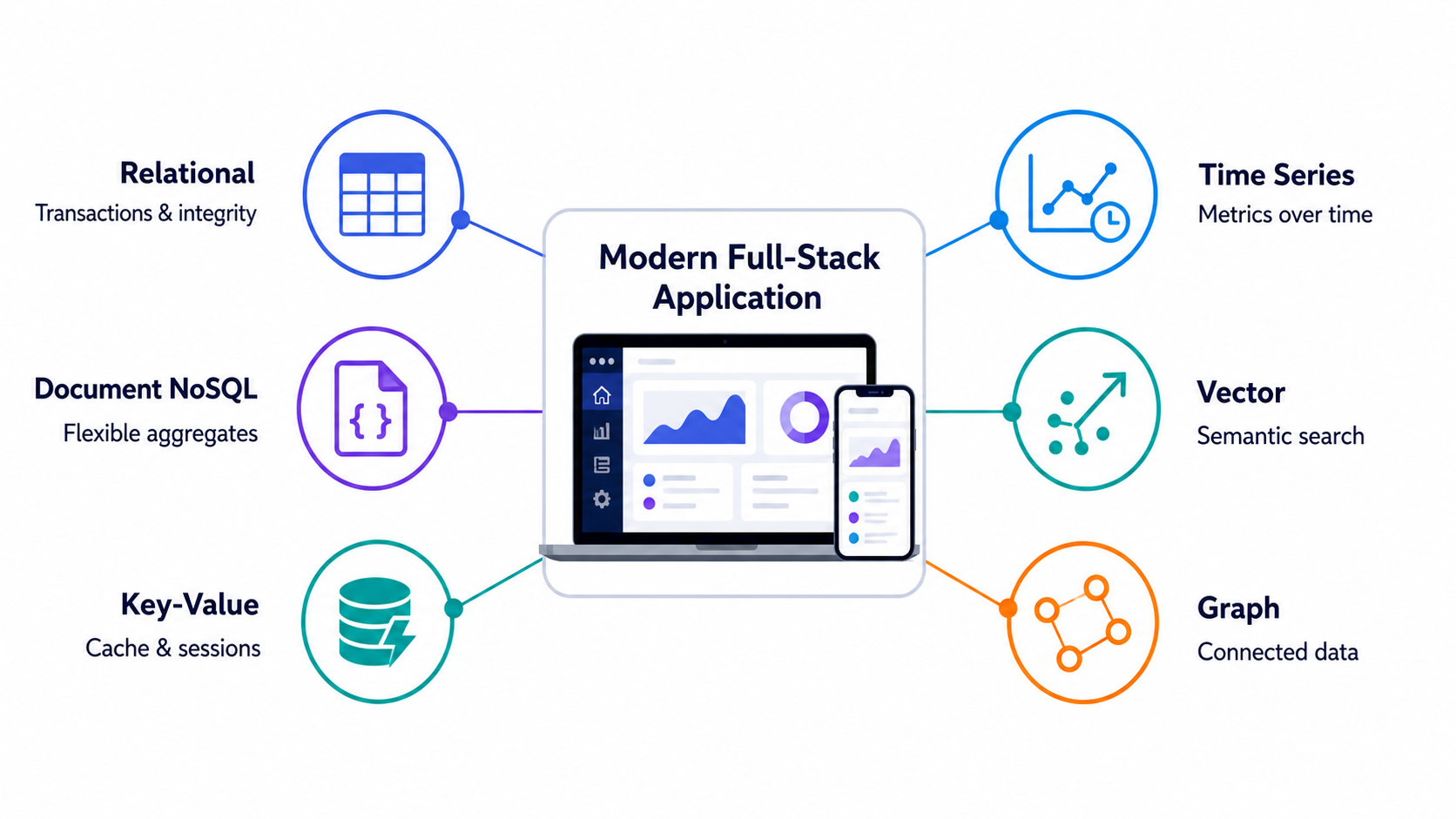
Different databases optimize different jobs. A full-stack engineer should identify correctness rules, access patterns and growth before selecting technology.
Relational
Structured business data, relationships, constraints and multi-step transactions.
NoSQL
Document, key-value, wide-column and graph models for particular access patterns.
Vector & time series
Semantic similarity on one side; timestamped, append-heavy measurements on the other.
Workload
Example record
Natural fit
Order
9001 · customer 42 · paid · ₹79,999
Relational
Session
session:abc123 → customer 42 · expires 10:30
Key-value
API metric
10:15:30 · checkout · 184 ms
Time series
Semantic representation
product-101 → vector + metadata
Vector
Pragmatic default: keep one clearly identified system of record. Add specialized stores only when the workload earns the complexity.
02
Translate business language into a schema.
ShopSphere requirements
Customers maintain addresses.
Products belong to categories.
Orders contain products and reserve inventory.
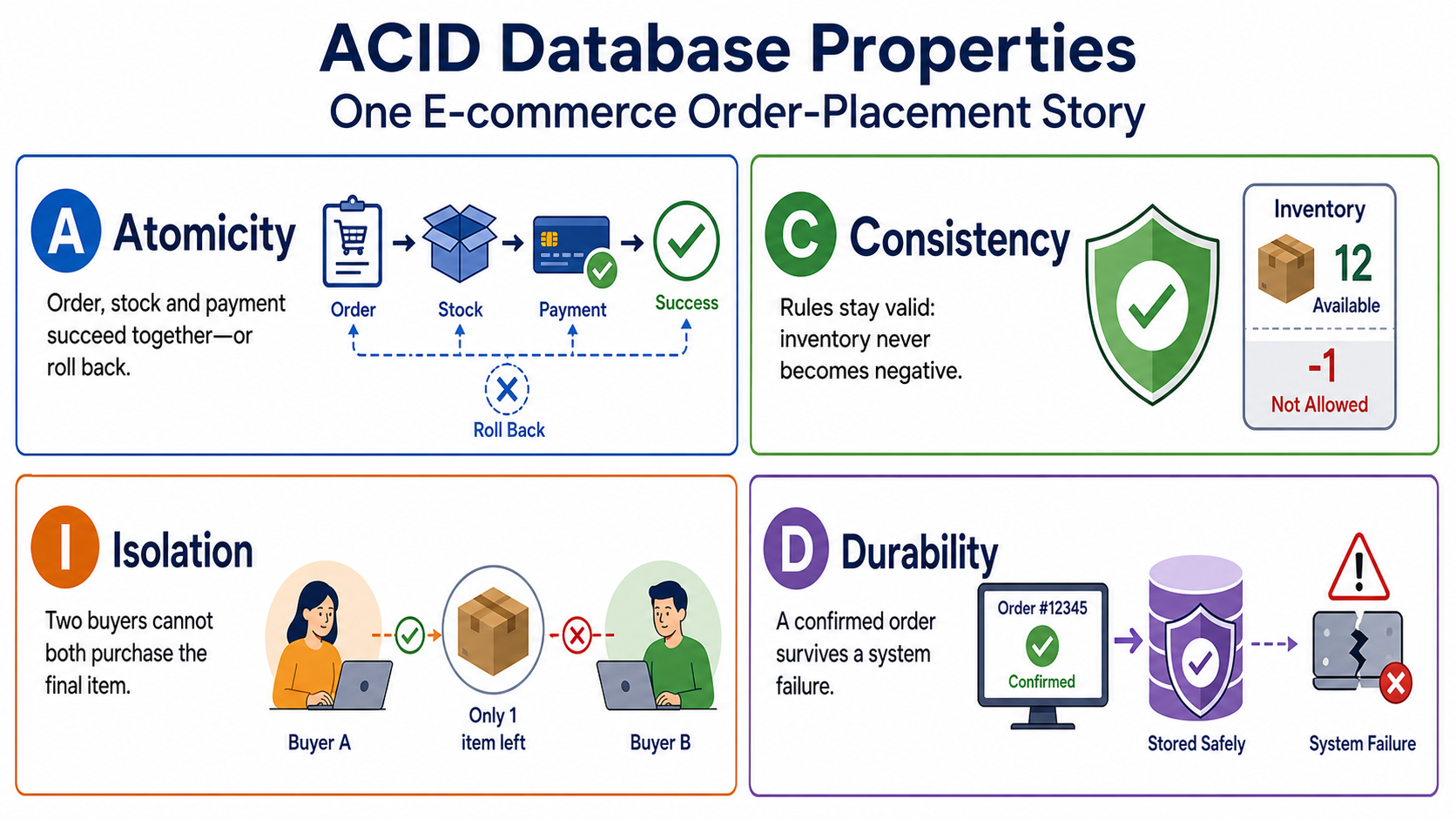
Payment and stock must not partially update.
Natural-language product search is required.
Questions before tables
What must survive?
What rules must always be true?
What are the important reads and writes?
Which steps belong together?
How will volume grow?
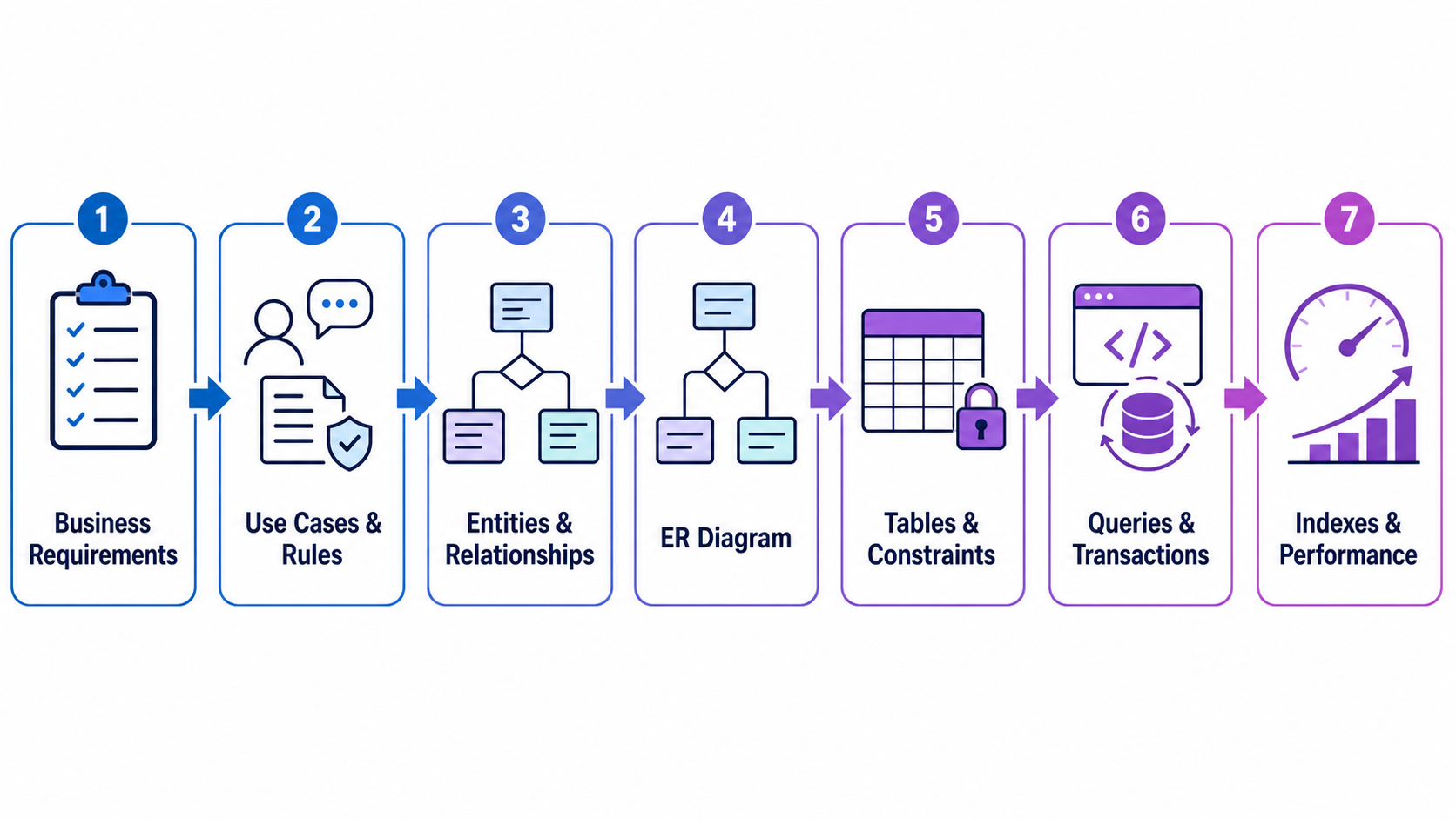
Conceptual → logical → physical
1
Conceptual model: business entities and relationships, independent of a database product.
2
Logical model: tables, columns, primary keys, foreign keys and normalization.
3
Physical model: PostgreSQL types, indexes, partitions and storage decisions.
Write down invariants
An invariant is a condition that must remain true after every valid transaction.
Product price cannot be negative.
Inventory cannot fall below zero.
An order item must reference a real order and product.
A paid order must have an associated payment record.
Constraints protect structural invariants; transaction logic protects multi-step business invariants.
CUSTOMER
PK customer_id
email UNIQUE
full_name
1 places N
ORDER
PK order_id
FK customer_id
status
total_amount
1 contains N
ORDER_ITEM
PK order_id + product_id
quantity
unit_price
order_id · PK
customer_id · FK
status
total
9001
42
paid
₹79,999
9002
42
shipped
₹1,499
9003
43
pending
₹4,299
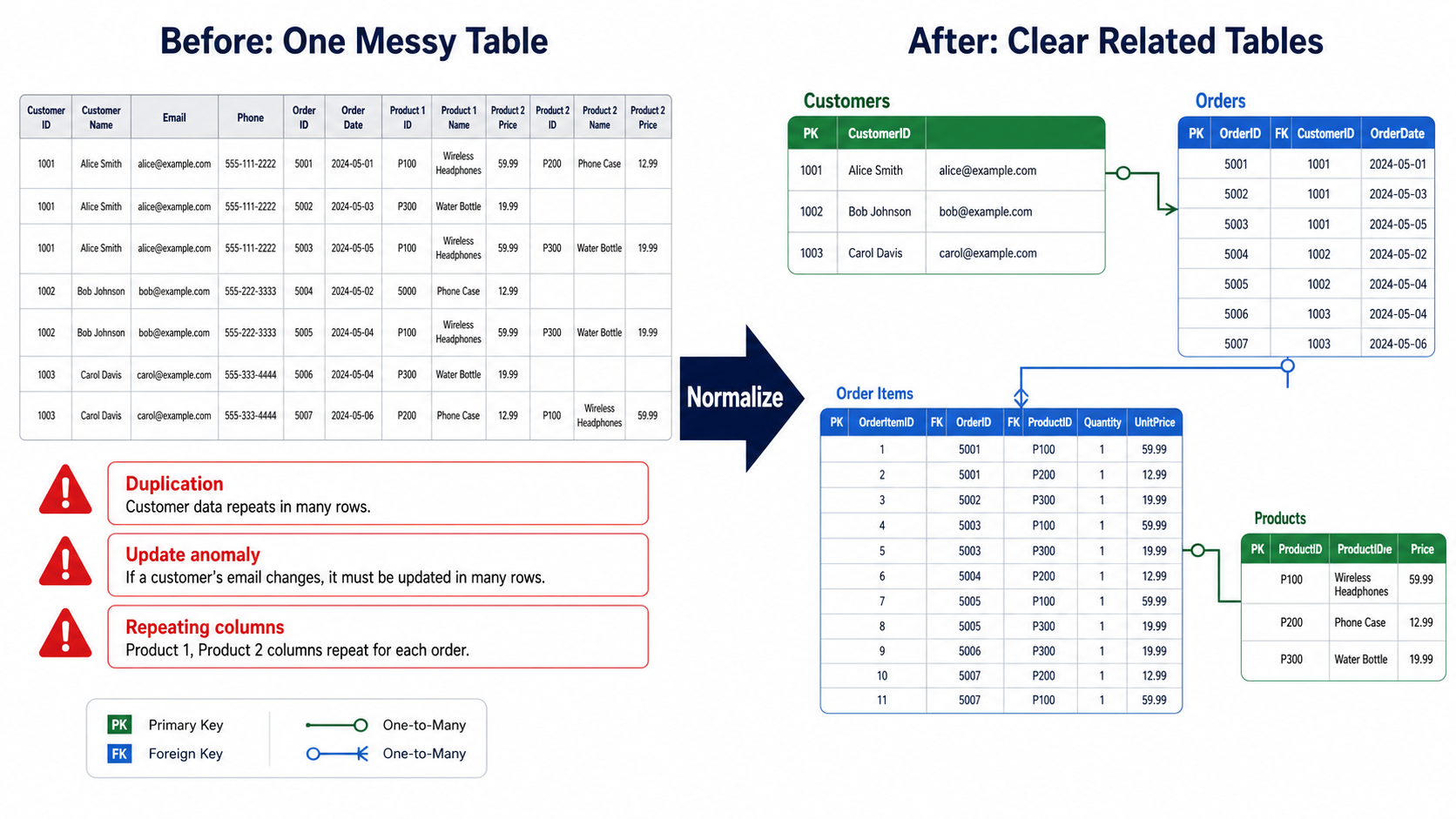
Rows 9001 and 9002 point to the same customer without duplicating that customer's email or name.
03
Read every relationship in both directions.
“One customer places many orders” also means “each order belongs to one customer.” The second sentence reveals where the foreign key belongs.
The composite primary key prevents product 101 from being assigned to category 10 twice.
Delete behaviour is part of design. Use CASCADE for disposable children, RESTRICT for protected history, and SET NULL only for optional links.
Five-question relationship test
How many B records can one A have?
How many A records can one B have?
Is either side optional?
Does the relationship carry its own data?
What should happen when either side is deleted?
Example: Enrollment is not merely a connector between Student and Course when it also stores enrollment date, status, completion and score. It is a business entity.
04
Give every fact one dependable home.
1NF
No repeating product columns. Store one order-item fact per row.
2NF
Every non-key fact depends on the entire key.
3NF
Customer facts belong to customers—not to orders.
PostgreSQL · Constraints protect every writer
CREATE TABLE products (
  product_id BIGINT GENERATED ALWAYS AS IDENTITY PRIMARY KEY,
  sku        VARCHAR(50) NOT NULL UNIQUE,
  name       VARCHAR(200) NOT NULL,
  price      NUMERIC(12,2) NOT NULL CHECK (price >= 0),
  status     VARCHAR(20) NOT NULL CHECK
             (status IN ('draft', 'active', 'discontinued'))
);
Attempted product row
Result
Rule
101 · LAP-14 · ₹79,999 · active
Accepted
All constraints satisfied
102 · LAP-14 · ₹69,999 · active
Rejected
Duplicate UNIQUE sku
103 · TAB-10 · ₹-500 · active
Rejected
CHECK price ≥ 0
104 · NULL · ₹25,000 · active
Rejected
NOT NULL sku
Normalized table
Example row
Fact represented
customers
42 · anita@example.com · Anita Rao
Who the customer is
orders
9001 · customer 42 · paid
Who placed the order
order_items
9001 · product 101 · quantity 1
What was purchased
order_items
9001 · product 205 · quantity 2
Another item in the same order
05
Choose precise types. Express changes safely with SQL.
A data type defines which values a column accepts and which operations are valid. SQL defines structures, changes rows, reads results and controls transactions.
Core PostgreSQL data types
Category
Common type
Column example
Example value
Whole number
INTEGER / BIGINT
quantity INTEGER
3
Exact decimal
NUMERIC(12,2)
price
79999.00
Short text
VARCHAR(n)
sku VARCHAR(50)
LAP-14
Long text
TEXT
description
Lightweight laptop…
Boolean
BOOLEAN
is_active
TRUE
Calendar date
DATE
date_of_birth
1992-04-18
Real-world instant
TIMESTAMPTZ
ordered_at
2026-08-19 10:15+05:30
Flexible structure
JSONB
specifications
{"ramGb":16}
Semantic representation
VECTOR(n)
embedding
[0.12,-0.44,…]
Money
Use Java BigDecimal and SQL NUMERIC. Binary floating point can introduce rounding artifacts.
Time
Use DATE for a calendar date and TIMESTAMPTZ for an instant viewed across time zones.
NULL
NULL means missing or unknown. It is different from zero and an empty string. Test it with IS NULL.
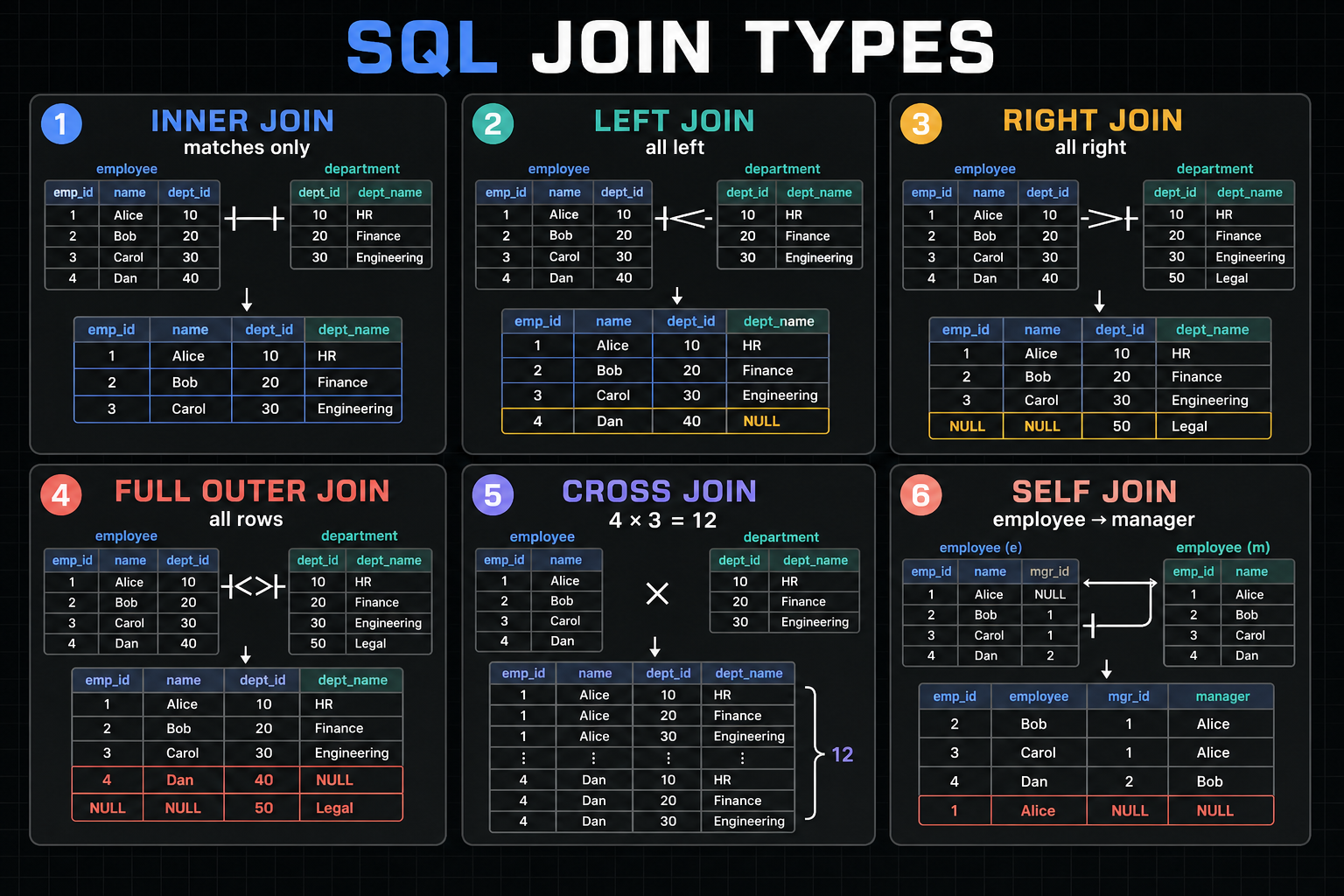
Reading rule: start with the left table. Must unmatched left rows remain? Must unmatched right rows remain? Those two decisions reveal the join type.
Aggregation
GROUP BY
SELECT status,
       COUNT(*) AS product_count,
       AVG(price) AS average_price
FROM products
GROUP BY status
ORDER BY status;
status
product_count
average_price
active
2
40374.25
draft
1
24999.00
Logical query order: FROM / JOIN → WHERE → GROUP BY → HAVING → SELECT → ORDER BY → LIMIT.
06
How backend code reaches the database.
The controller handles HTTP. The service owns business rules and the transaction. The repository performs data access. The pool manages scarce connections.
ControllerHTTP
→
Servicebusiness + transaction
→
Repositorydata access
→
ORM / JDBCmapping + SQL
→
Driverprotocol
→
Poolconnections
→
PostgreSQLtruth
JDBC driver
Authenticates, sends SQL and parameters, converts types, returns rows and reports database errors.
ORM
Maps Java objects and relationships to rows. It reduces CRUD boilerplate but does not remove the need to understand SQL.
Connection pool
Reuses a bounded set of connections. Calling close normally returns a borrowed connection to the pool.
HTTP Request
→
Borrow Connection
→
Run Transaction
→
Return Connection
Java · JPA entity
@Entity@Table(name = "products")
public class Product {
@Id @GeneratedValueprivate Long productId;
@Column(nullable = false, unique = true)
private String sku;
private BigDecimal price;
}
Key idea: begin, every SQL statement, commit and rollback must use the same Connection.
Do not hold a database transaction open while waiting for a remote payment provider. Use short local transactions, idempotency and a reliable event/outbox workflow.
Transaction step
If it fails before commit
Reserve inventory
No order exists; inventory update is rolled back
Create order
Inventory reservation is rolled back
Create order item
Order and inventory changes are rolled back
Commit
All successful changes become durable together
08
Make important queries fast—deliberately.
Without an index
The database may inspect every order to find one customer's history.
Row 1
Row 2
…
Row N
With a composite index
The database navigates directly to one customer's newest orders.
customer_id
→
ordered_at DESC
→
Top 20
SQL · Index and query plan
CREATE INDEX idx_orders_customer_date
ON orders (customer_id, ordered_at DESC);
EXPLAIN ANALYZE SELECT * FROM orders
WHERE customer_id = 42ORDER BY ordered_at DESC LIMIT20;
Query
Usefulness of (customer_id, ordered_at)
Reason
customer 42 + newest first
Excellent
Matches both columns
customer 42 only
Useful
Uses leading column
date only
Usually poor
Skips leading customer_id
status=paid
None
Status is absent
Column order
Composite indexes follow query patterns. The leading column matters.
Write cost
Every index consumes storage and adds work to inserts and updates.
N+1
One list query plus one query per row is a backend access-pattern problem.
09
NoSQL is a family of models—not a shortcut.
Document model
Embed bounded data read together. Reference entities with independent lives or unbounded growth.
A five-minute downsample can turn these into one row: checkout · requests 3 · average 241.3 ms · errors 1.
If the dominant need is…
Start by considering…
Example
Correct multi-row business operations
Relational
Orders and payments
Flexible bounded aggregates
Document
Variable catalogue specifications
Very fast key lookup
Key-value
Sessions and cache
Timestamp windows and retention
Time series
API latency and IoT readings
Semantic similarity
Vector
Natural-language product search
10
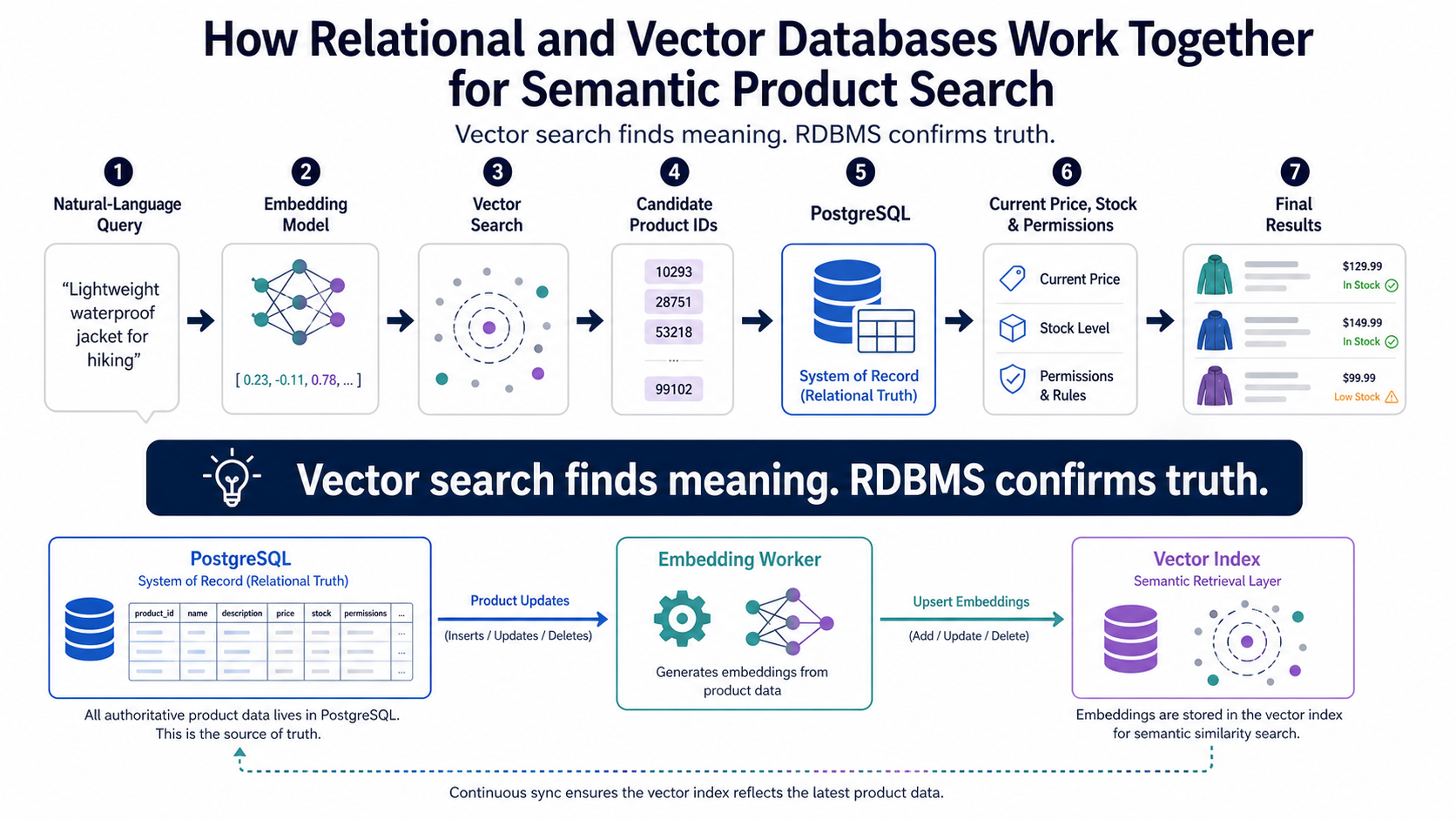
Search by meaning, then confirm current truth.
Product text
→
Embedding modelnumbers capture meaning
→
Vector index
←
Query embedding
←
Natural-language query
Embedding
A numeric representation where semantically related inputs tend to be close.
Top-K retrieval
Return the nearest candidate IDs using cosine, dot-product or Euclidean distance.
Metadata filters
Restrict results by tenant, permission, status, category or price band.
PostgreSQL · pgvector
SELECT p.product_id, p.name, p.price,
1 - (pe.embedding <=> :query_embedding) AS similarity
FROM product_embeddings pe
JOIN products p ON p.product_id = pe.product_id
WHERE p.status = 'active'AND p.price <= 100000ORDER BY pe.embedding <=> :query_embedding
LIMIT10;
Vector lifecycle
Read authoritative content.
Build searchable text or chunks.
Generate an embedding.
Store vector, stable ID and metadata.
Re-embed when source content changes.
Delete vectors when access or source records disappear.
Keep authoritative price, inventory, payment and permissions in the relational system of record. Treat vectors as search representations.
PostgreSQL · source of truth
product
price
stock
status
101 · TravelBook 14
₹79,999
6
active
Vector index · search representation
vector
product
hash
indexed
product-101
101
a81f…
14:20:04
Outbox synchronization rows
outbox_id
event
product
status
attempts
771
product.updated
101
processed
1
772
product.updated
205
pending
0
773
product.deleted
310
retry
2
12
Apply the full design method.
Learning platform scenario
Learners enroll in courses, complete lessons, make payments, search lesson content semantically, and generate video-playback telemetry.
Identify entities and relationships.
Choose primary and foreign keys.
Add five integrity constraints.
Normalize to approximately 3NF.
Define the paid-enrollment transaction.
Propose two indexes.
Decide whether document NoSQL is justified.
Design a time-series playback event.
Define vector text and metadata.
Explain source-to-vector synchronization.
Reference solution
Core entities: User, Course, Module, Lesson, Enrollment, LessonProgress and Payment. Resolve users ↔ courses through Enrollment. Keep payment/enrollment changes transactional locally. Store playback telemetry by timestamp. Store lesson chunks and access-tier metadata in the vector index.
Reflection: If only one database could remain in this architecture, which would it be? The answer reveals the system of record.