Cloud & AI Agents Masterclass
Understand what cloud is, where every major service belongs, how to design a secure solution, and how AWS, Microsoft and Google run production AI agents.
Cloud turned infrastructure into an on-demand utility.
The revolution was programmable capacity: provision in minutes, pay for use, scale automatically and discard safely.
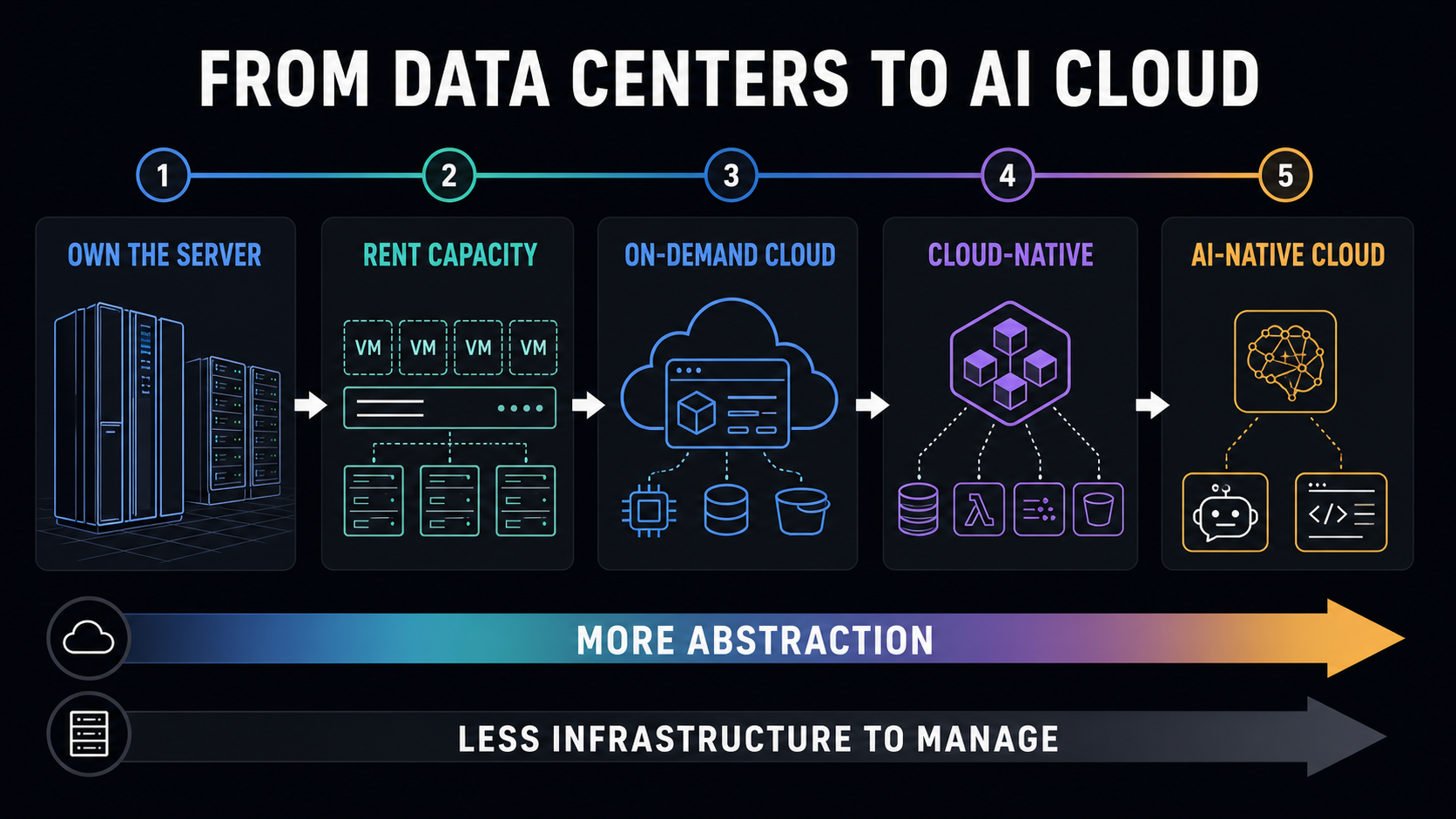
Data center
Buy servers, predict peak demand and operate everything.
Virtualization
Share hardware across isolated virtual machines.
Public cloud
Rent compute, storage, networks and managed platforms through APIs.
Cloud native
Containers, serverless, automation, observability and managed AI.
Think in layers, locations and responsibility.
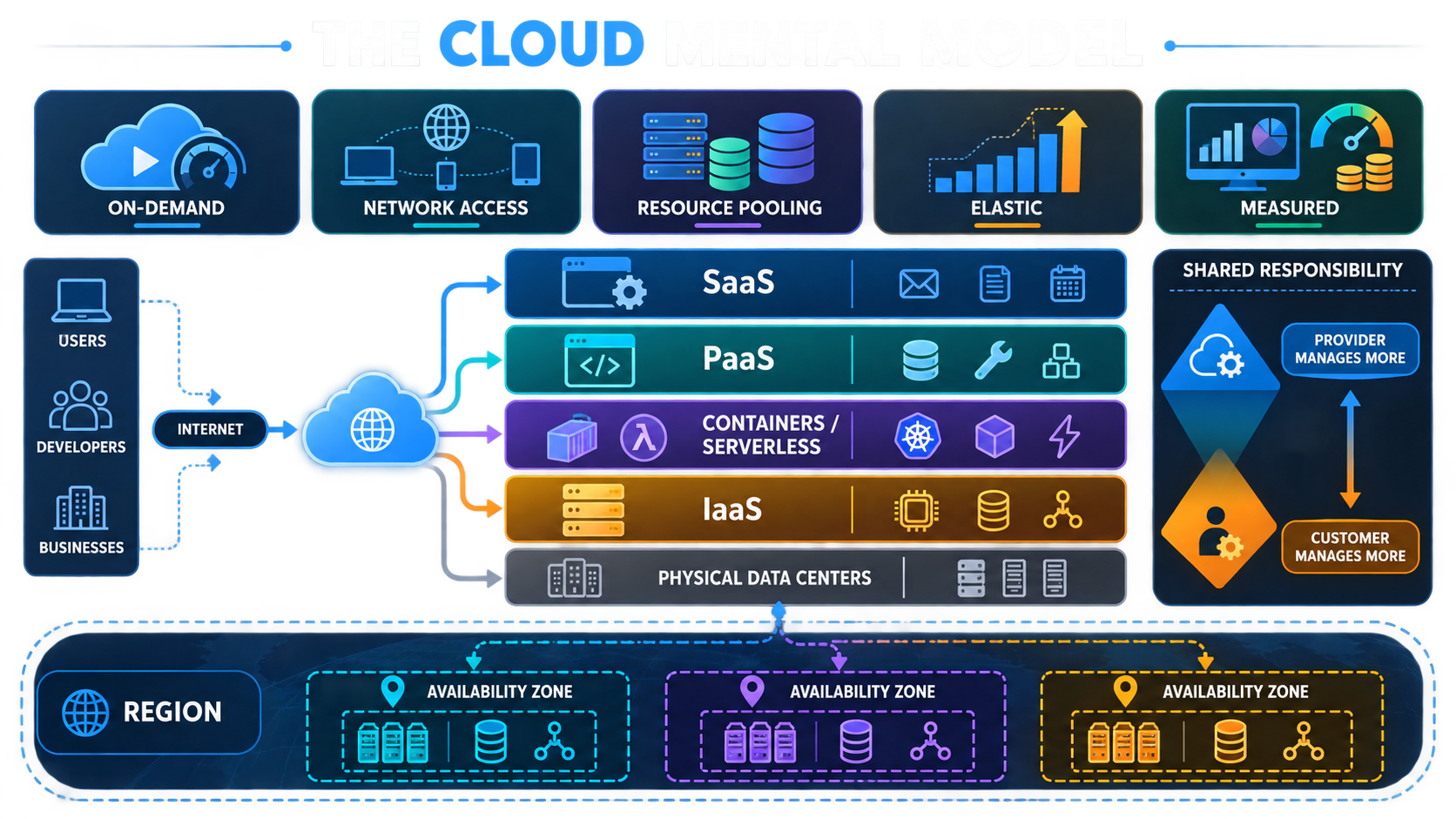
Service model
IaaS: control the OS. PaaS: deploy code. Serverless: run on demand. SaaS: use the application.
Deployment model
Public, private, hybrid or multi-cloud—chosen because of real constraints.
Location model
A region contains isolated availability zones; edge locations serve users nearby.
Every cloud catalog is built from familiar categories.
Compute
VMs, containers, Kubernetes, functions and app platforms.
Data
Object storage, relational, NoSQL, cache, warehouse and streaming.
Network
Virtual networks, DNS, load balancers, gateways, CDN and private links.
Platform
Identity, secrets, monitoring, messaging, DevOps, analytics and AI.
| Need | Start with | Reason |
|---|---|---|
| Conventional or legacy server | Virtual machine | OS-level control |
| Portable web/API service | Managed containers | Container portability with less operations |
| Bursty event-driven code | Function/serverless | Scale to demand |
| Transactional system of record | Managed relational DB | Constraints and transactions |
| Files, media, backups, lake | Object storage | Durable blobs at massive scale |
| Decouple services | Queue or pub/sub | Survive spikes and temporary failures |
Cloud is an ecosystem, not a rack of rented servers.
A successful platform joins governance, identity, networking, compute, data, delivery and operations into one repeatable operating model.
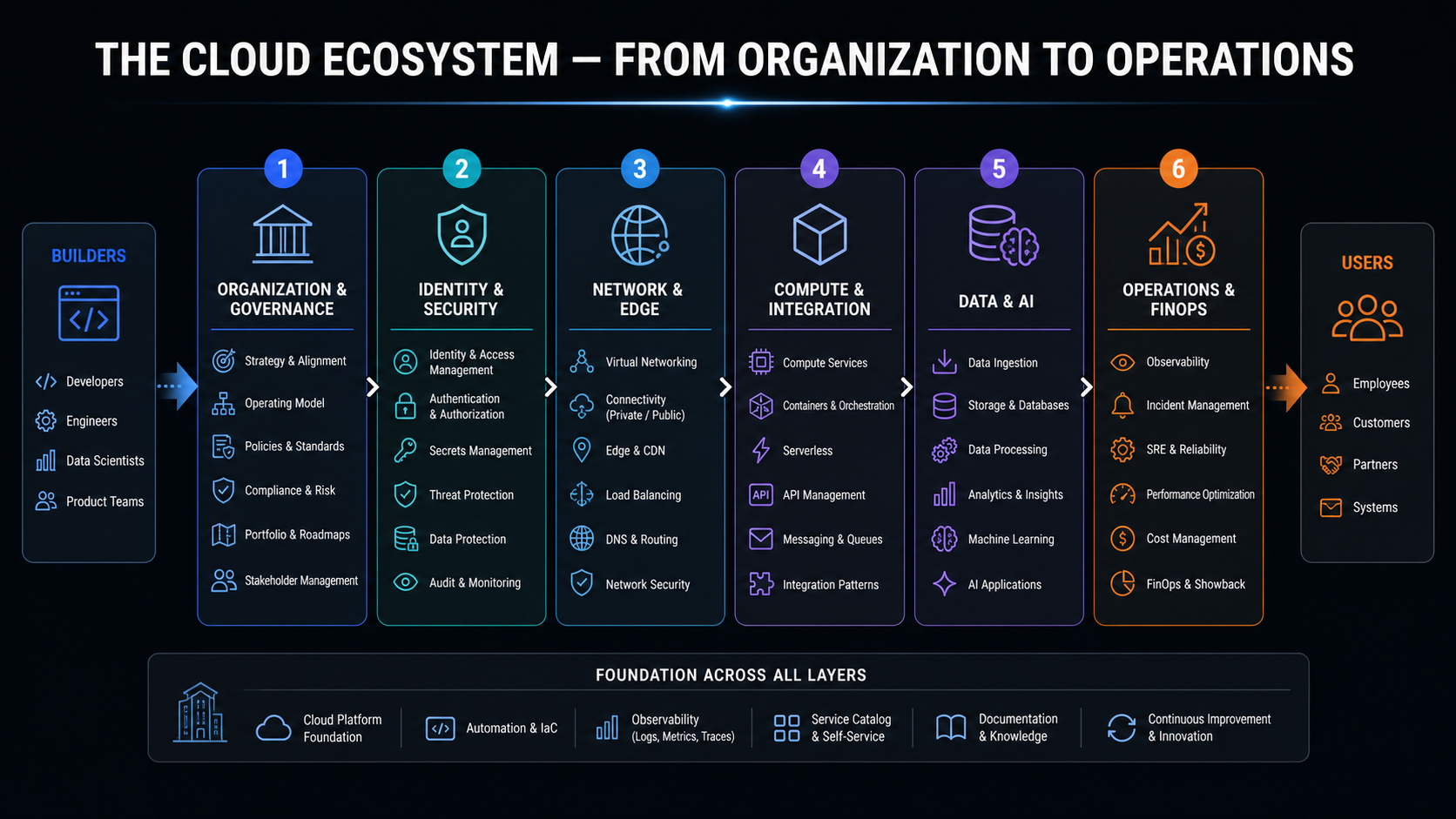
| Layer | Core question | Capabilities |
|---|---|---|
| Organization & governance | Who owns the platform and which rules apply? | Account hierarchy, standards, policy, compliance and risk |
| Identity & security | Who or what can access which resource? | Federation, MFA, roles, workload identity, secrets and threat detection |
| Network & edge | How do users and services communicate? | VPC/VNet, DNS, CDN, WAF, load balancing and private endpoints |
| Compute & integration | Where does code run and how is work connected? | VMs, containers, functions, APIs, queues and event buses |
| Data & AI | Where is truth stored and intelligence created? | Databases, object stores, warehouses, models and vector search |
| Operations & FinOps | How do we know it works and what it costs? | Telemetry, SLOs, incidents, budgets and unit economics |
Platform engineering
Paved roads, reusable IaC, approved images, golden CI/CD and a service catalog give teams safe self-service.
Partner ecosystem
Marketplaces, SaaS integrations, partners, training, certification and support affect adoption.
Data gravity
Existing identity, data and skills often matter more than a small difference in compute price.
Learn categories first; translate product names second.
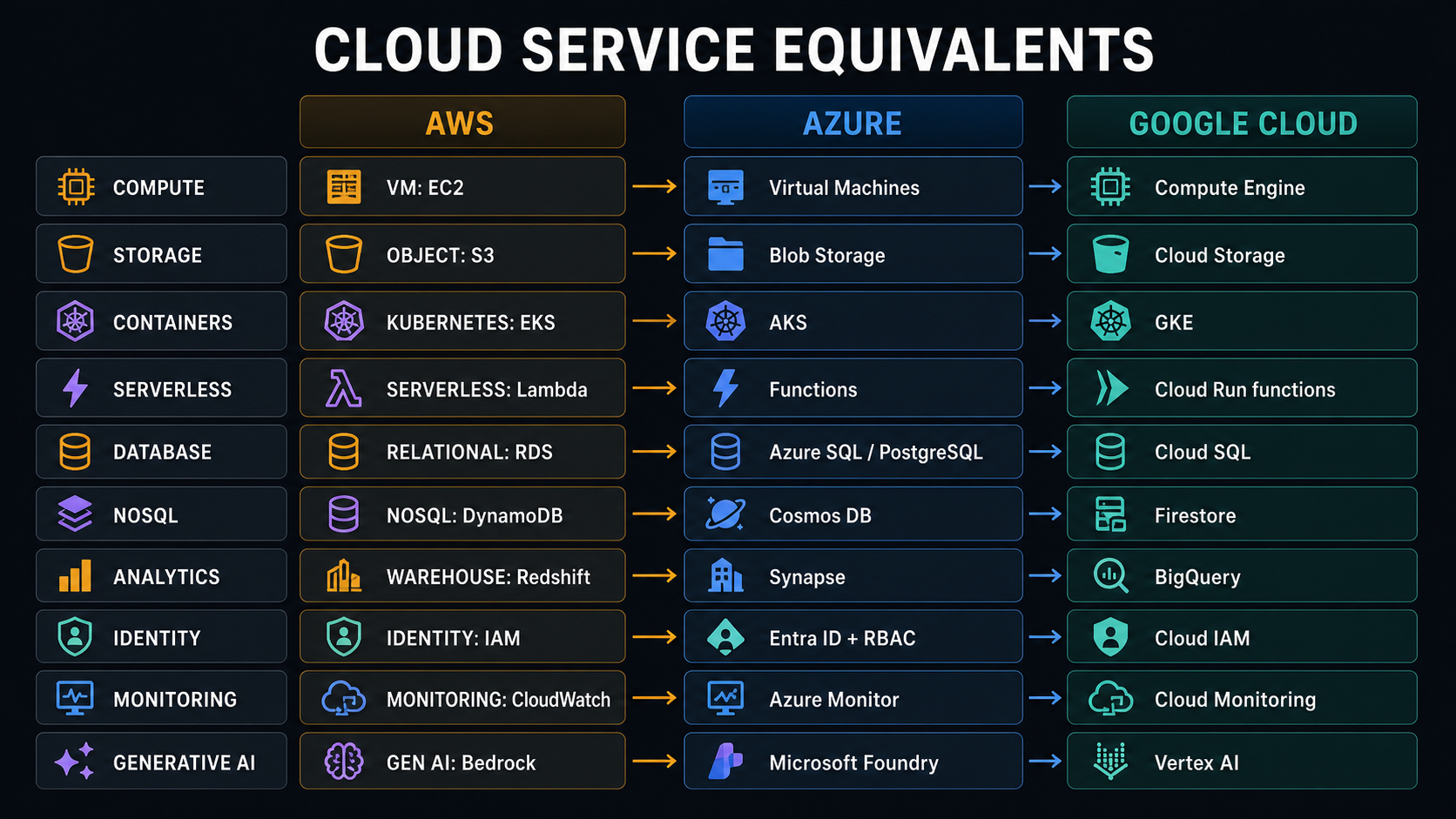
| Category | AWS | Microsoft Azure | Google Cloud |
|---|---|---|---|
| Virtual machines | EC2 | Virtual Machines | Compute Engine |
| Object storage | S3 | Blob Storage | Cloud Storage |
| Kubernetes | EKS | AKS | GKE |
| Functions | Lambda | Azure Functions | Cloud Run functions |
| Managed containers | ECS/Fargate, App Runner | Container Apps | Cloud Run |
| Relational DB | RDS/Aurora | Azure SQL | Cloud SQL/AlloyDB |
| NoSQL | DynamoDB | Cosmos DB | Firestore/Bigtable |
| Warehouse | Redshift | Fabric/Synapse | BigQuery |
| Messaging | SQS/SNS/EventBridge | Service Bus/Event Grid | Pub/Sub/Eventarc |
| Secrets | Secrets Manager | Key Vault | Secret Manager |
| Monitoring | CloudWatch/X-Ray | Azure Monitor/App Insights | Cloud Monitoring/Trace |
| Foundation models | Amazon Bedrock | Microsoft Foundry | Vertex AI |
Choose the constraint, then the platform, then the service.
1. Constraints
Residency, compliance, latency, availability, contracts and team expertise.
2. Workload
Traffic shape, state, runtime, batch versus online, models and data gravity.
3. Operations
Prefer the highest-level managed service that meets the requirement safely.
| Context signal | Natural starting point—not a rule |
|---|---|
| Large existing AWS estate | AWS |
| Microsoft 365, Entra, .NET and Azure data | Microsoft Azure |
| BigQuery, data/AI, Kubernetes and Google ecosystem | Google Cloud |
| Small team and uncertain traffic | Managed app/container platform + managed database |
| Regulated workload | The provider meeting residency, evidence, controls and support requirements |
Architect from user journey to failure modes.
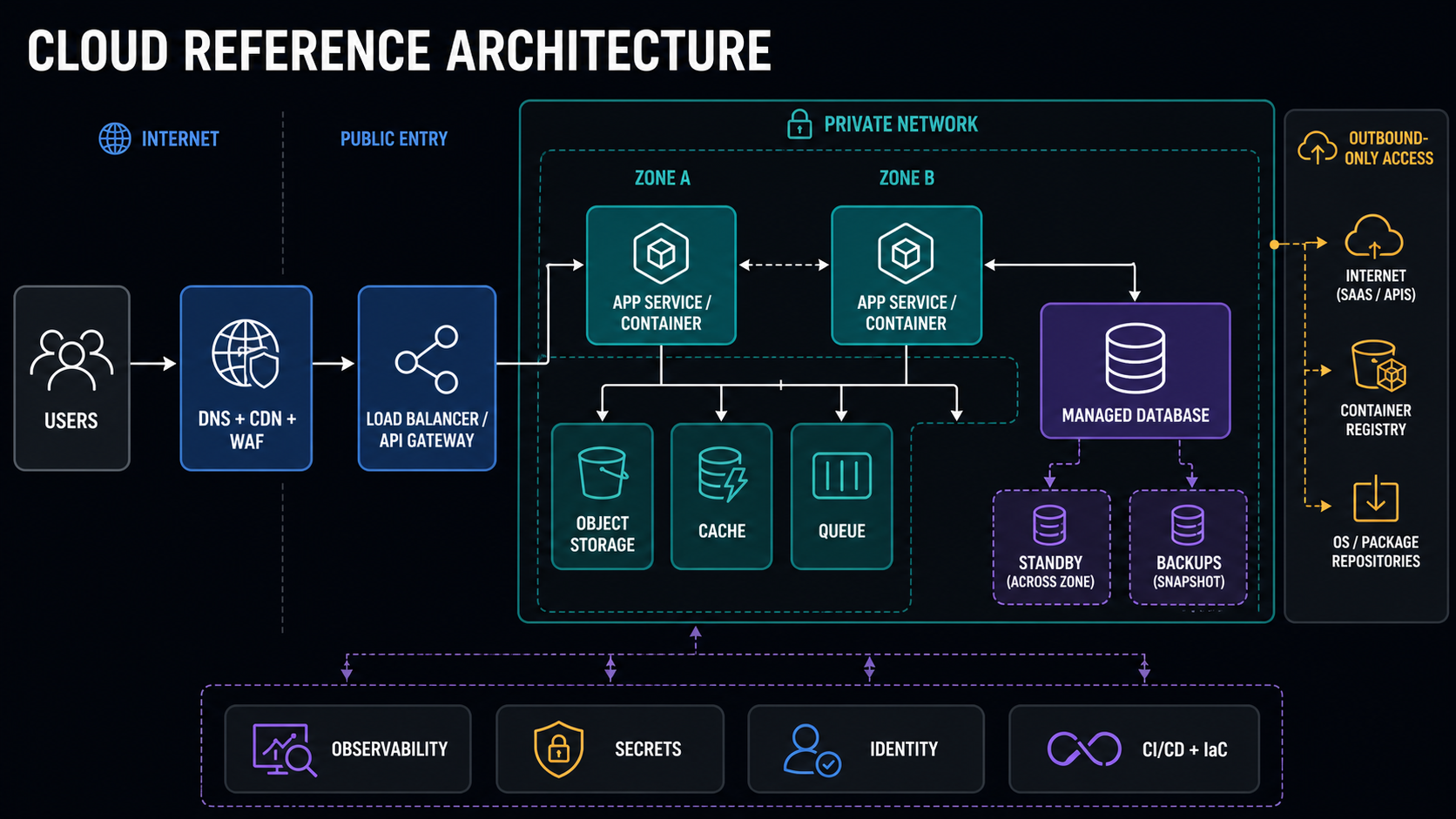
Synchronous
Keep user-facing requests short, bounded and observable.
Asynchronous
Queue durable work; make consumers idempotent and retry-safe.
Control plane
IaC, CI/CD, secrets, logs, metrics, traces, alerts and audit.
Design for failure, scale and cost together.
Reliability
Multi-zone deployment, health checks, timeouts, backups and tested recovery.
Performance
Measure latency, cache deliberately, batch calls and remove network hops.
Scale
Stateless compute, queues, partitioned work and backpressure.
Cost
Tag resources, budget, right-size, autoscale and delete idle environments.
| Question | Artifact |
|---|---|
| How much data can we lose? | Recovery Point Objective (RPO) |
| How long can recovery take? | Recovery Time Objective (RTO) |
| What does healthy mean? | SLIs and SLOs |
| What if a dependency slows? | Timeout, circuit breaker, queue, graceful degradation |
| Who owns the bill? | Tags, budgets, dashboards and unit economics |
Security is defense in depth, starting with identity.
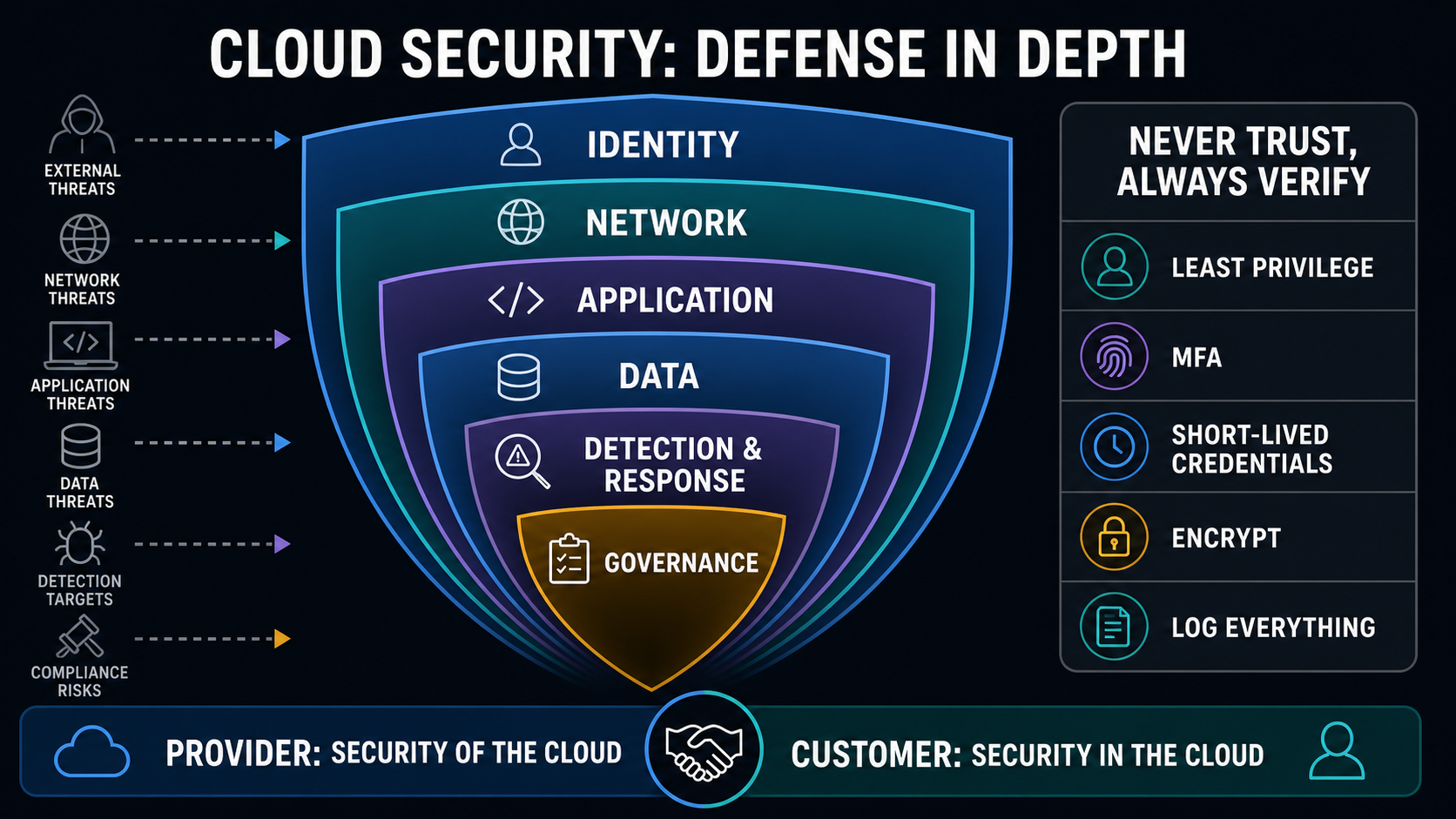
Identity
Short-lived credentials, least privilege, MFA and workload identities.
Data
Classify, encrypt, restrict, rotate secrets and audit access.
Detection
Central logs, configuration policy, threat signals and incident playbooks.
| Agent risk | Practical control |
|---|---|
| Destructive tool call | Allowlist, scoped identity, policy check and human approval |
| Sensitive data in prompts | Classification, redaction, access-aware retrieval and retention |
| Prompt injection from content | Treat content as data; validate tool arguments |
| Unexpected behavior | Evals, traces, versioned prompts, canary and rollback |
IAM separates identity proof from permission.
Authentication proves who or what made the request. Authorization decides whether that principal may perform an action on a resource under the current conditions.
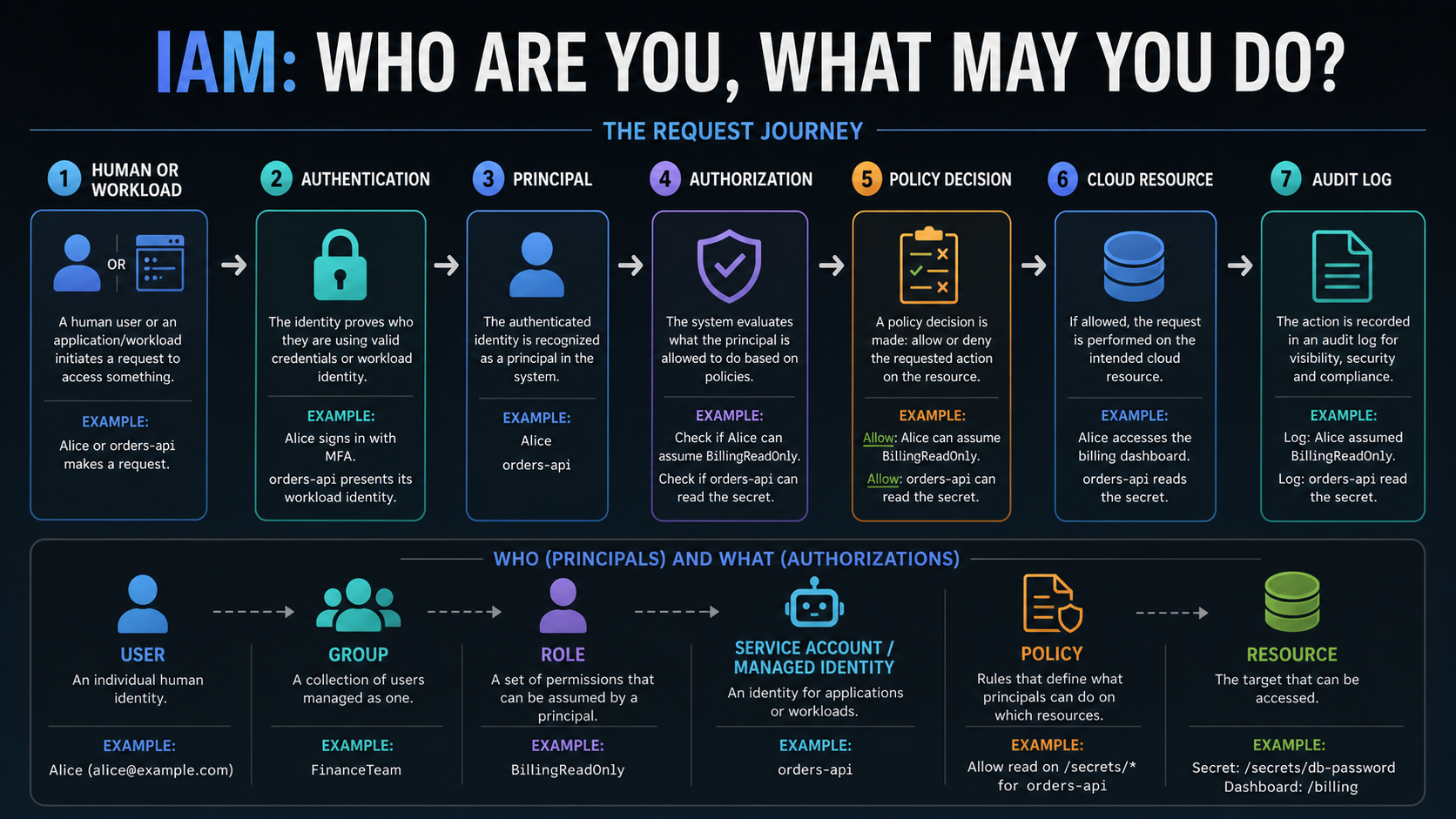
| Concept | Meaning | Example |
|---|---|---|
| Identity | Human or workload known to the system | Alice; orders-api |
| Principal | Authenticated identity making this request | Alice's temporary role session |
| Group | Administrative collection of people | FinanceTeam |
| Role | Assumable set of permissions | BillingReadOnly |
| Workload identity | Non-human identity without embedded keys | Managed identity/service account |
| Policy | Rules over principal, action, resource and conditions | Allow read of one secret |
Humans
Federate from the company identity provider, require MFA, assume temporary roles and use privileged-access workflows.
Workloads
Attach a managed identity, service account or role to the runtime. Never bake keys into code or images.
Audit
Record identity, session, requested action, target, decision, source and result in protected logs.
IAM evaluates principal, action, resource and conditions.
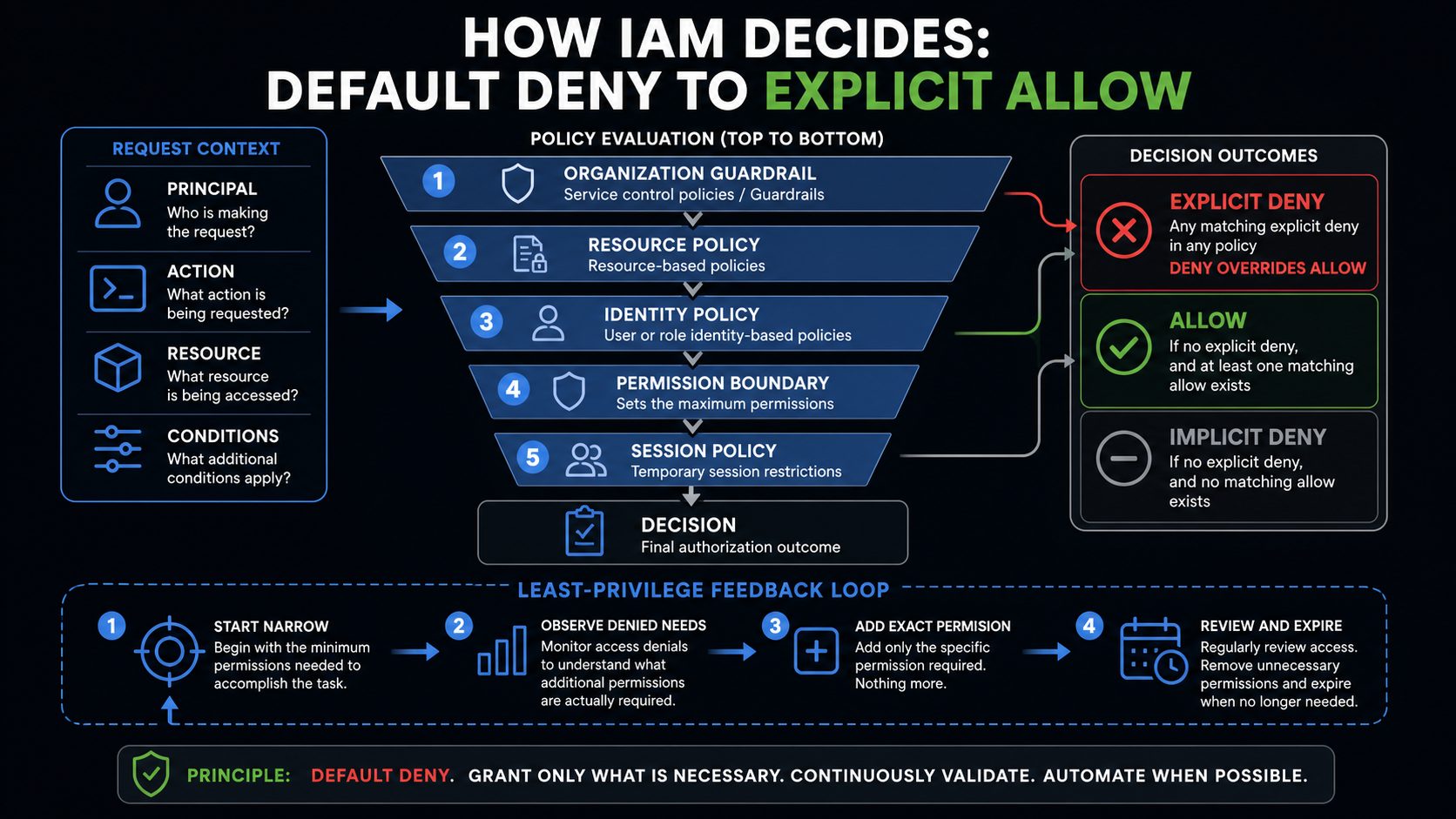
Explicit deny
Any applicable explicit deny overrides an allow.
Explicit allow
With no deny, at least one applicable allow must match.
Implicit deny
If no policy grants access, the default decision is deny.
Effective permission is an intersection
Organization guardrails, resource policies, identity policies, permission boundaries and session policies combine to determine the maximum permission. Conditions can restrict network, device, time, region, tags, authentication strength and resource attributes.
| Bad pattern | Better design |
|---|---|
| Shared administrator account | Named identity + federation + temporary privileged role |
| Long-lived key in CI | OIDC/workload federation with short-lived token |
| Action:* Resource:* | Exact actions on tagged or named resources |
| Direct user permissions | Groups and roles aligned to job functions |
| Permanent production access | Just-in-time, approved and expiring access |
Build the secure foundation before deploying workloads.
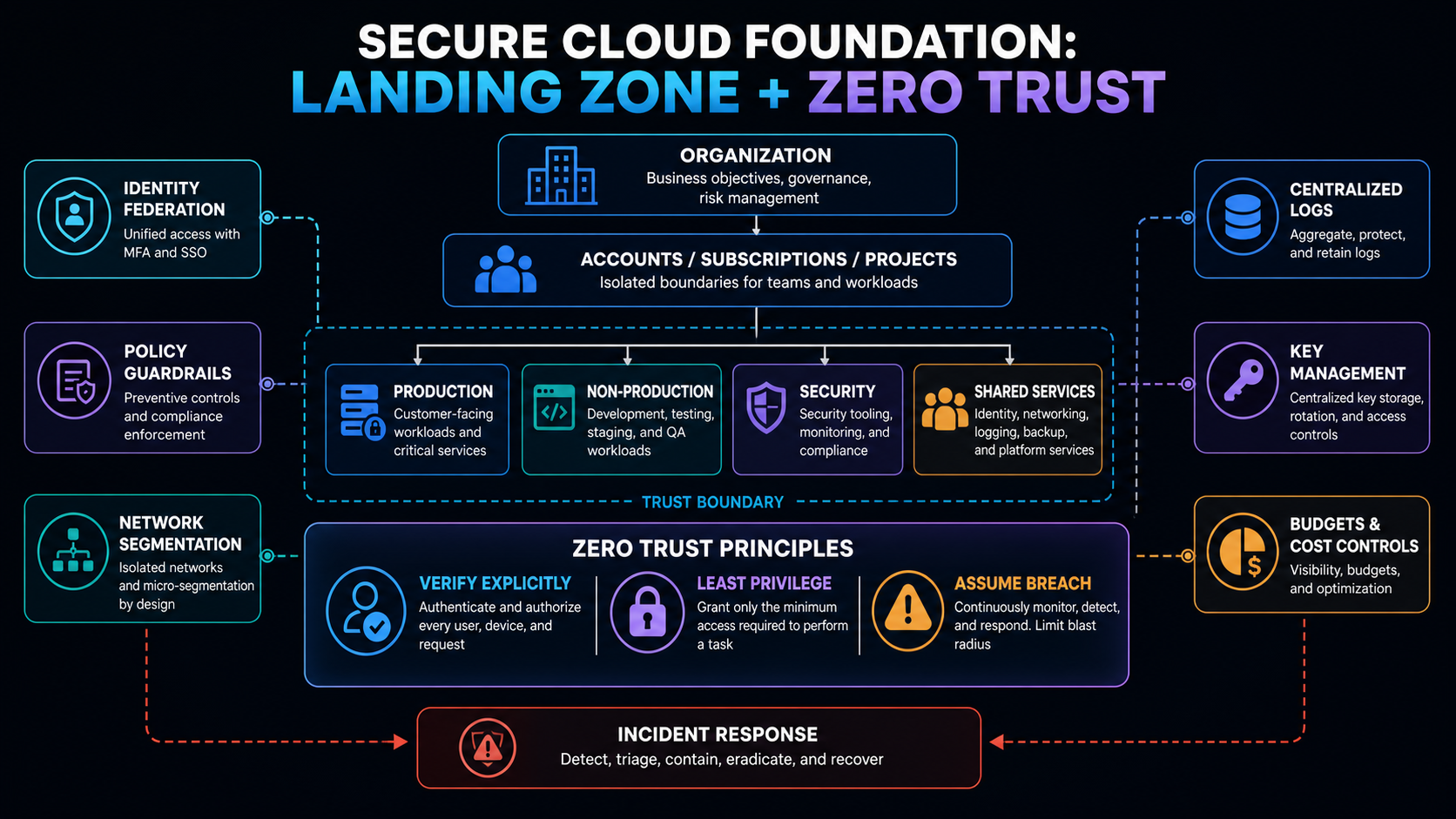
A landing zone establishes account structure, identity federation, networking, centralized logging, encryption, budgets and policy guardrails before application teams deploy.
Verify explicitly
Evaluate identity, device, workload, location and risk for every request.
Least privilege
Use short-lived, just-in-time and just-enough access.
Assume breach
Segment networks, protect logs, limit blast radius and rehearse containment.
| Boundary | Purpose |
|---|---|
| Organization / tenant | Company-wide governance, billing and policy |
| Management group / organizational unit | Policy inheritance by business purpose |
| Account / subscription / project | Workload, billing and blast-radius isolation |
| Production / non-production / security / shared services | Separate duties and trust zones |
| Resource tags and folders | Ownership, environment, data class and cost attribution |
Cloud is an API; the console is only one client.
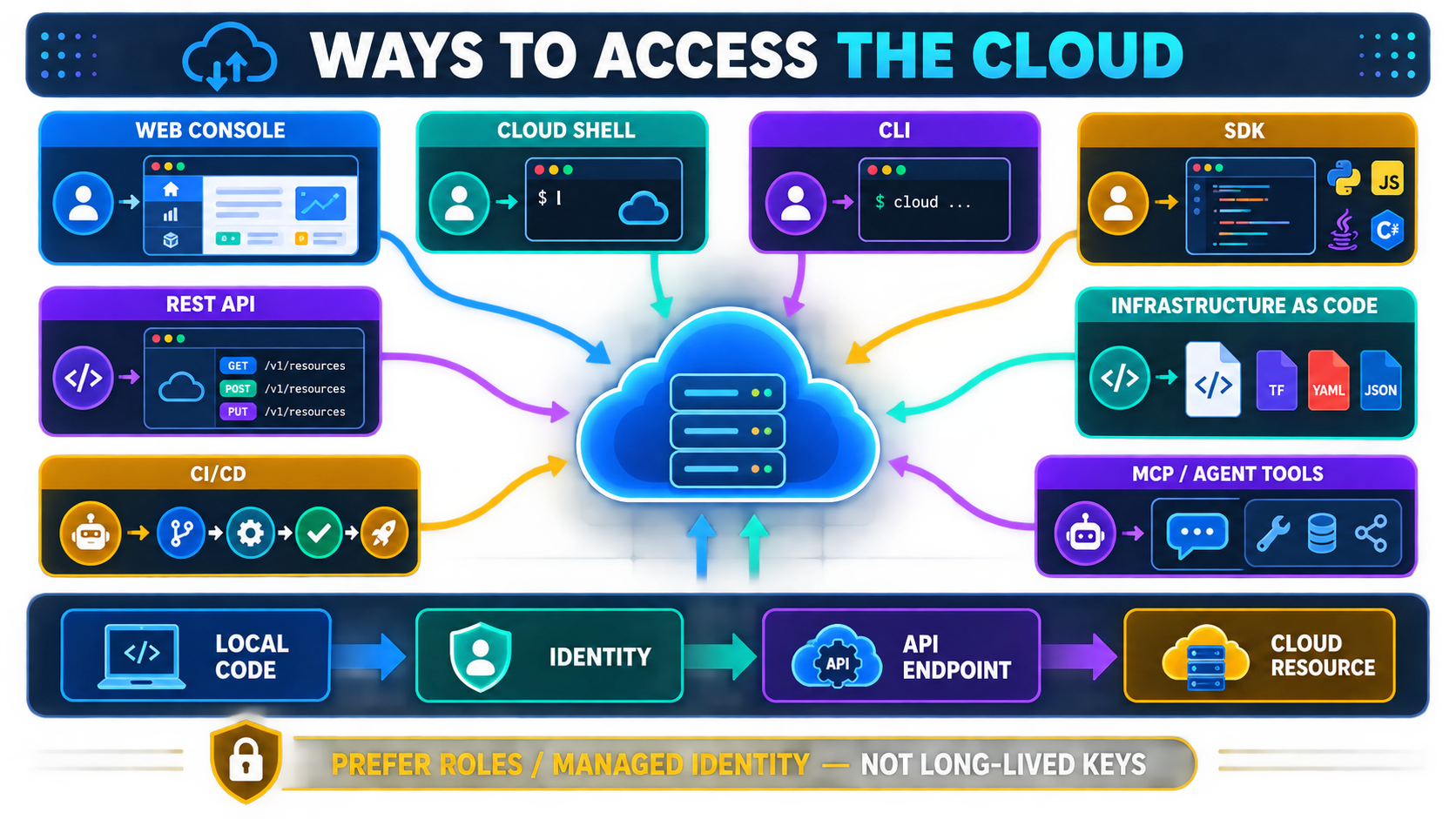
Explore
Console and Cloud Shell help humans discover and diagnose.
Automate
CLI, SDK and REST let scripts and applications call services.
Reproduce
Terraform and native IaC make infrastructure reviewable.
Operate
CI/CD uses workload identity to deploy approved changes.
# AWS
aws sts get-caller-identity

# Microsoft Azure
az account show

# Google Cloud
gcloud auth list
gcloud config get-value projectimport boto3
s3 = boto3.client("s3")
s3.upload_file("report.pdf", "workshop-files", "reports/report.pdf")
url = s3.generate_presigned_url(
"get_object",
Params={"Bucket": "workshop-files", "Key": "reports/report.pdf"},
ExpiresIn=900,
)
print(url)resource "aws_s3_bucket" "workshop" {
bucket = "company-workshop-files"
tags = { environment = "training", owner = "platform-team" }
}
resource "aws_s3_bucket_versioning" "workshop" {
bucket = aws_s3_bucket.workshop.id
versioning_configuration { status = "Enabled" }
}A model predicts; an agent pursues a goal through tools and state.
Model
Understands context and proposes the next action.
Instructions
Define role, boundary, output and escalation.
Tools
Read or change the world through APIs and enterprise systems.
Loop
Observe → reason → act → inspect → stop, continue or ask.
state = {"goal": user_request, "messages": []}

while not state.get("done"):
    decision = model.decide(state, tools=allowed_tools)
    if decision.requires_approval:
        decision = human.review(decision)
    result = tools.call(decision.tool, decision.arguments)
    state["messages"].append({"decision": decision, "result": result})
    state["done"] = policy.stop(state)

return model.answer(state)Use the least autonomous option that solves the problem.
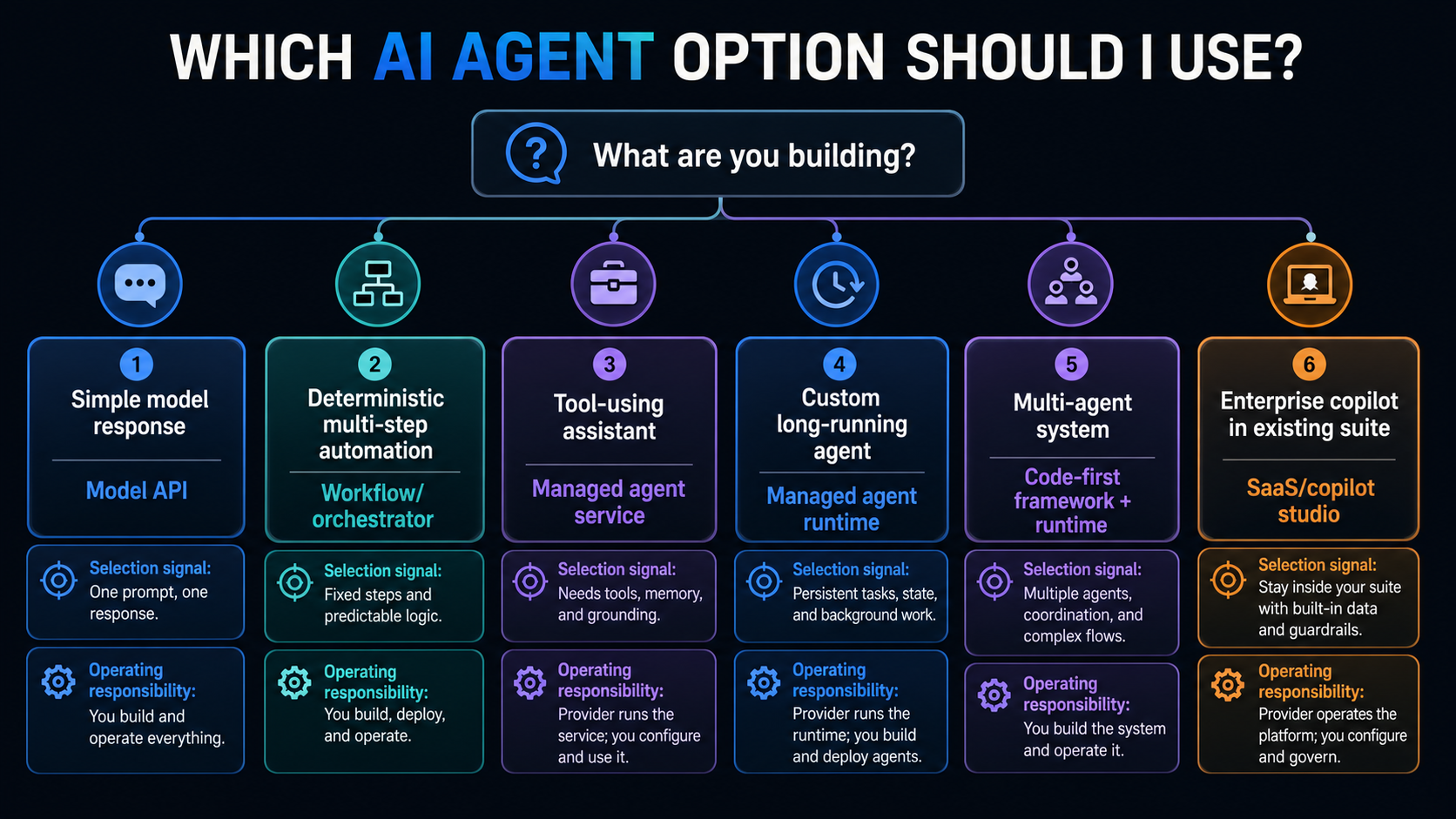
| Need | Start with | You operate |
|---|---|---|
| One request and response | Model API | Prompt, validation and call |
| Fixed predictable steps | Workflow/orchestrator | Logic, retries and integrations |
| Bounded tool-using assistant | Managed agent service | Instructions, tools, data and policy |
| Long-running/background agent | Managed agent runtime | Agent code, deployment and evaluation |
| Coordinated specialists | Code-first multi-agent framework + runtime | Topology, state, handoffs and failures |
| Existing enterprise suite | SaaS copilot/studio | Configuration, connectors and governance |
The autonomy ladder
Runtime
Does it need streaming, long tasks, background work, durable state or isolation?
Interoperability
Are tools functions, REST APIs, MCP servers, enterprise connectors or other agents?
Control
Can identity propagate? Can traces and evals export? Can models and tools be versioned independently?
A production agent is a system, not a prompt.
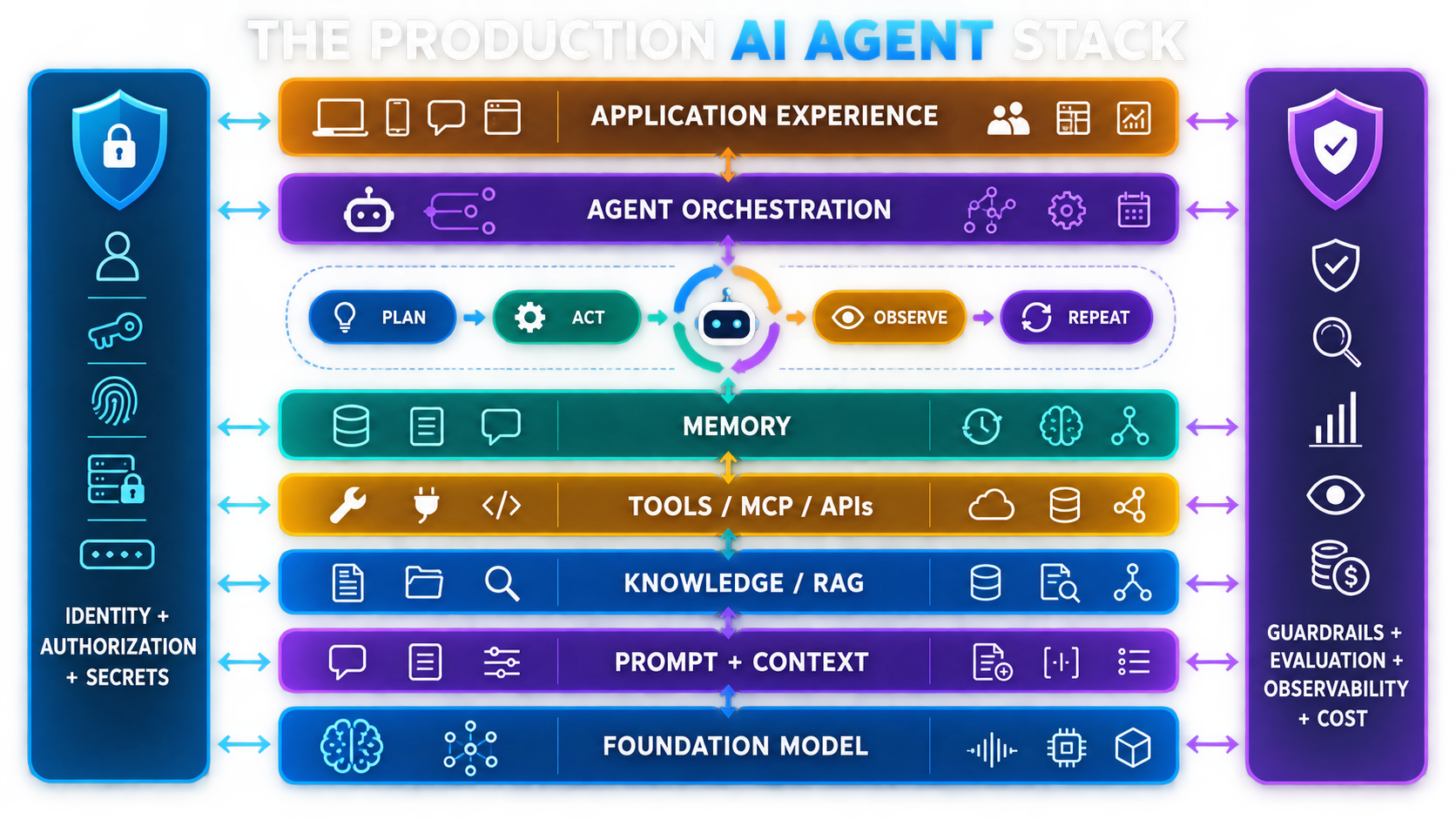
Runtime
Isolation, streaming, long-running work, scale, retries and deployment.
Context
Session state, memory, retrieval, files and enterprise knowledge.
Control
Identity, policy, approvals, guardrails, traces, evaluations and releases.
RAG, tools, memory, MCP and A2A solve different problems.
| Concept | Purpose | Example |
|---|---|---|
| RAG | Retrieve relevant knowledge before generation | Find the correct refund policy |
| Tool/function | Perform a bounded operation | Read an order or issue a refund |
| Memory | Carry useful state across steps or sessions | Remember language with consent |
| MCP | Standard agent-to-tool/context interface | Expose CRM search through an MCP server |
| A2A | Agent-to-agent collaboration | Delegate fraud review to a specialist agent |
The safe path separates reasoning from execution.
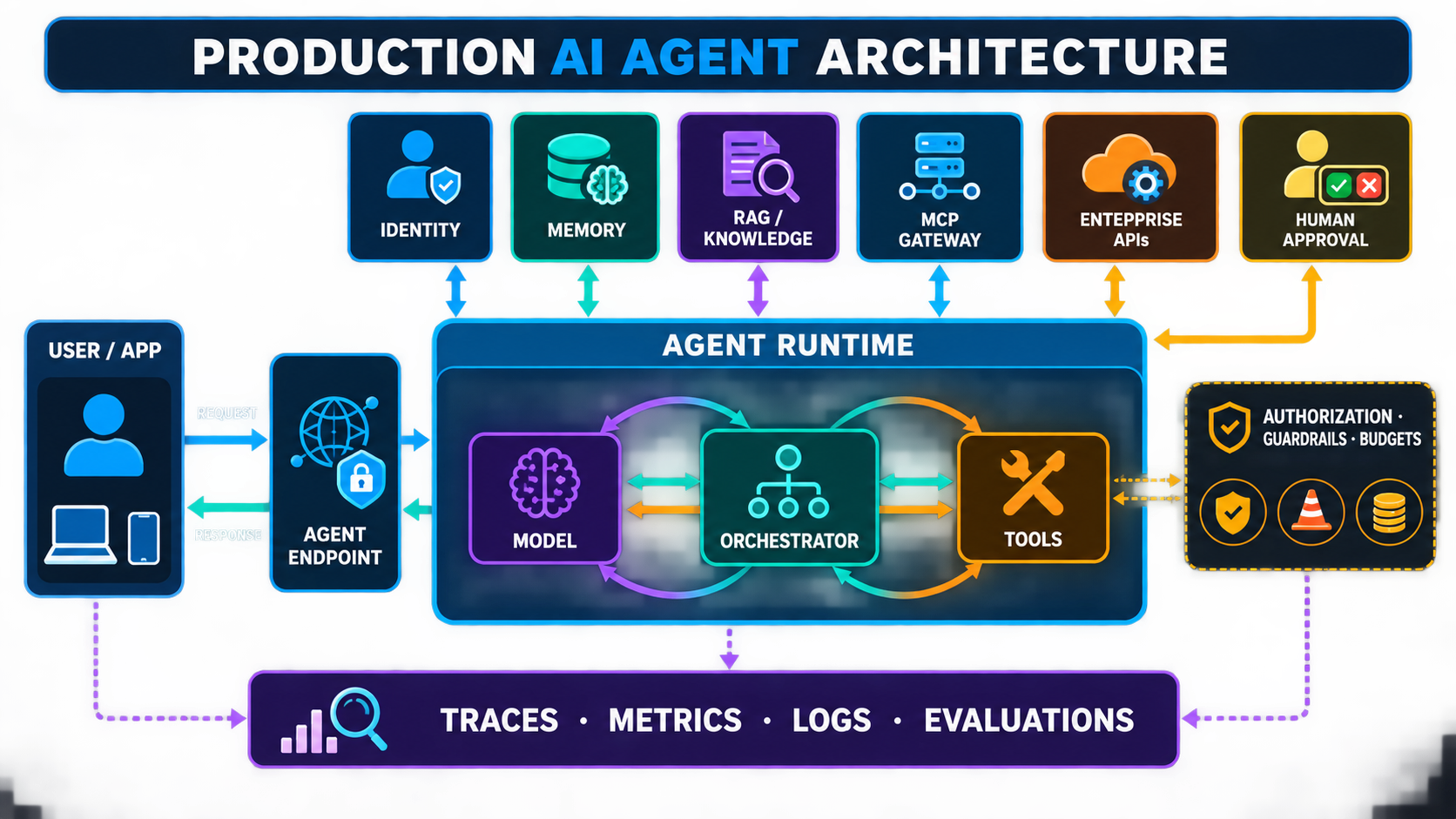
Read path
Identity-aware retrieval returns only permitted information.
Write path
Validate arguments, enforce policy, approve and record.
Learning path
Traces feed evaluations, incident analysis and controlled releases.
All three clouds provide the pieces; they package them differently.
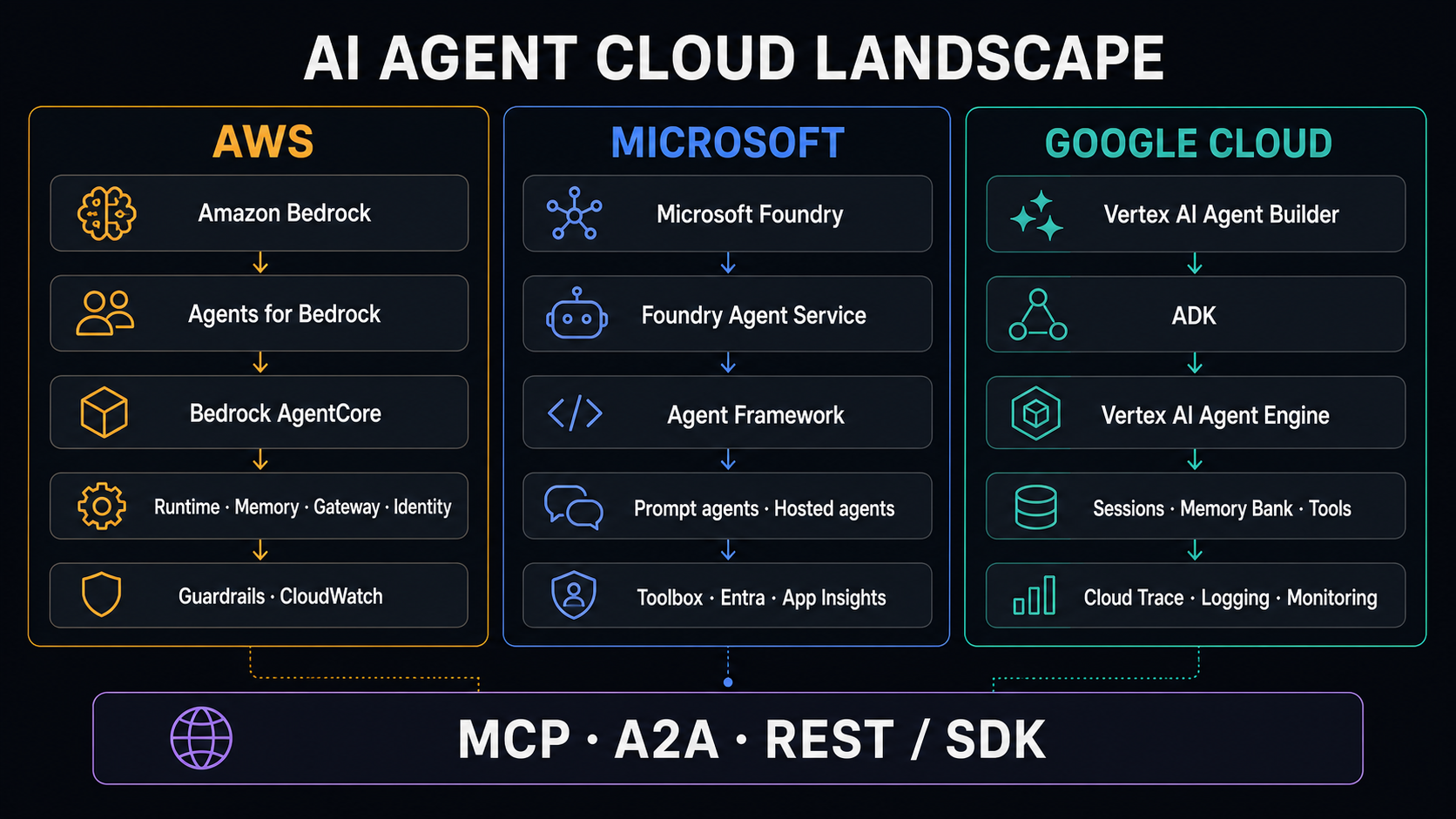
| Layer | AWS | Microsoft | Google Cloud |
|---|---|---|---|
| Model platform | Amazon Bedrock | Microsoft Foundry | Vertex AI |
| Managed agent path | Bedrock Agents / AgentCore | Foundry Agent Service | Agent Builder / Agent Engine |
| Code-first | Framework-flexible; Strands common | Microsoft Agent Framework | Agent Development Kit |
| Enterprise tools | AgentCore Gateway, Lambda, APIs | Foundry tools, Functions, Logic Apps | ADK tools, Cloud Run, APIs |
| Identity | IAM + AgentCore Identity | Entra ID + managed identity | Cloud IAM + service accounts |
| Observability | CloudWatch + AgentCore | App Insights / Azure Monitor | Cloud Trace/Logging + Agent Engine |
AWS: Bedrock for models; AgentCore for operating agents.
Build
Use Bedrock models, Bedrock Agents or a code-first framework.
Run
AgentCore Runtime hosts isolated agent workloads and long-running interactions.
Govern
Gateway, Identity, Memory, Policy, Guardrails, Observability and evaluations.
Microsoft: Foundry agents connected to the enterprise identity plane.
Build
Microsoft Agent Framework orchestrates code-first workflows; Foundry also supports prompt agents.
Run
Foundry Agent Service manages agents; hosted agents run custom agent code where available.
Connect
Foundry tools, Toolbox/MCP, Functions and Logic Apps with Entra and App Insights.
Google Cloud: ADK to build, Agent Engine to operate.
Build
ADK is a code-first framework for agents, workflows, tools, sessions and multi-agent patterns.
Run
Vertex AI Agent Engine provides runtime, sessions, memory, evaluation and observability.
Connect
Vertex models and grounding, BigQuery, Search, Cloud Run tools, MCP and A2A.
Agents require a continuous build–evaluate–release–operate loop.
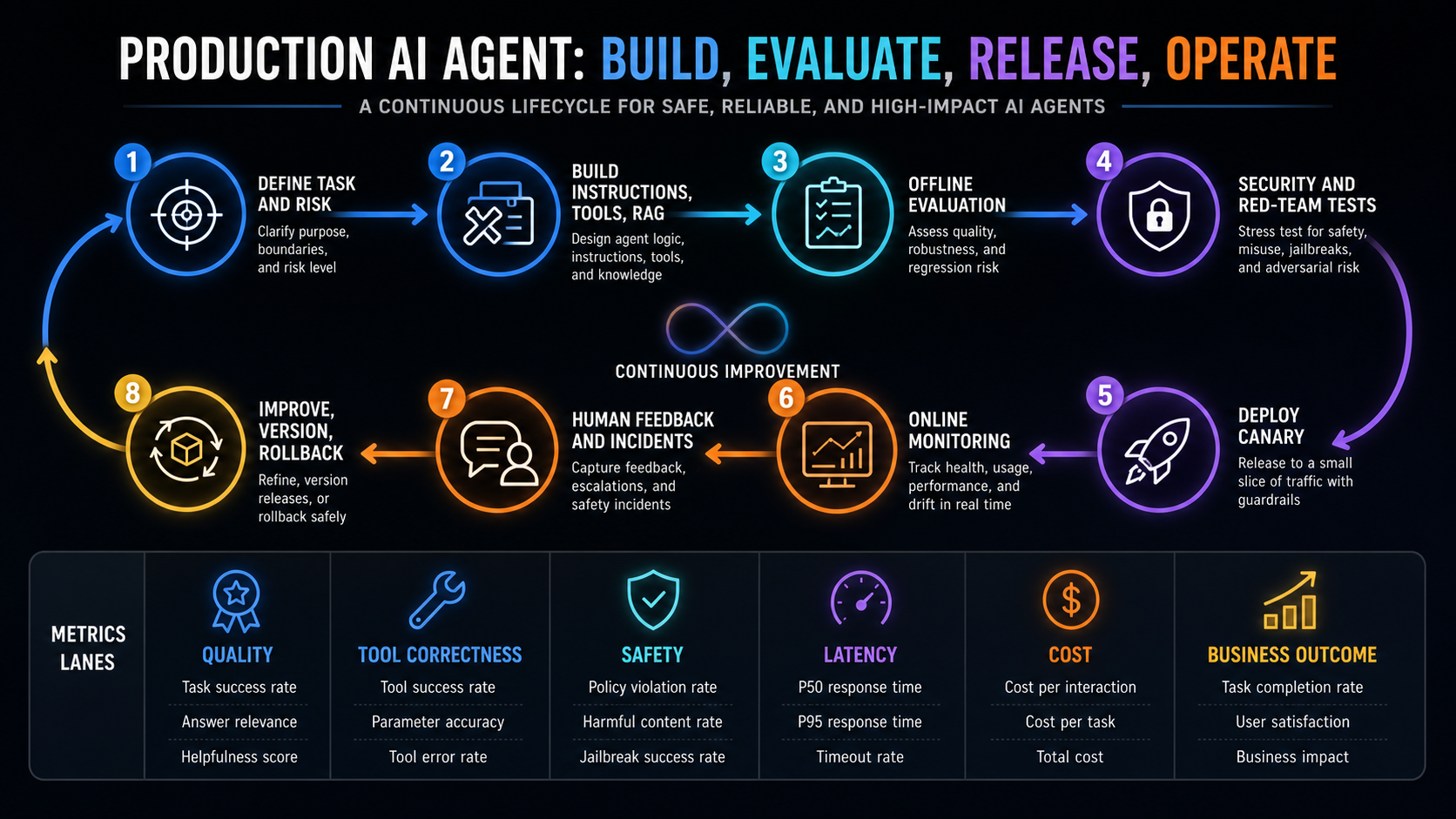
| Metric lane | Measure |
|---|---|
| Task quality | Correctness, relevance, groundedness and completion |
| Tool behavior | Correct tool, parameter accuracy, success, idempotency and side effects |
| Retrieval | Recall, ranking, permission filtering, citation and freshness |
| Safety | Policy violations, injection success, leakage and harmful action rate |
| Runtime | P50/P95 latency, timeout, retry and availability |
| Economics | Tokens, model/tool calls and cost per completed task |
| Business | Resolution, containment, satisfaction and human workload |
Golden cases
Normal, ambiguous, denied, missing-data, timeout, duplicate, hostile-content and escalation scenarios.
Correlated traces
Link model, retrieval, tools, policy and approval with exact version metadata.
Progressive release
Offline gates, canary cohort, online comparison, human oversight and tested rollback.
Select the smallest platform that safely closes the loop.
| Question | A strong answer contains |
|---|---|
| Where is authoritative data? | Systems, residency, permissions and freshness |
| What may the agent do? | Allowlisted tools, read/write boundary, approval and rollback |
| What must persist? | Session state, durable memory, consent and retention |
| How do we know it works? | Golden tasks, tool correctness, quality, safety, latency and cost |
| How will it run? | Runtime, identity, network, secrets, observability and recovery |
Complete example: customer-support agent
Read safely
Retrieve policies and orders using caller permissions; cite source and freshness.
Act safely
Validate limits, approve sensitive actions and make retries idempotent.
Improve safely
Trace, evaluate representative cases, canary releases and keep rollback ready.
- Name the workload and constraints.
- Choose the category before the product name.
- Prefer managed services when their limits fit.
- Draw user, data, trust and failure flows.
- Automate infrastructure and deployment.
- Measure reliability, security, quality and unit cost continuously.
Put everything together with the cloud.
Frontend, mobile, backend, databases and AI agents are deployed, connected, secured, scaled and observed through one cloud operating foundation.
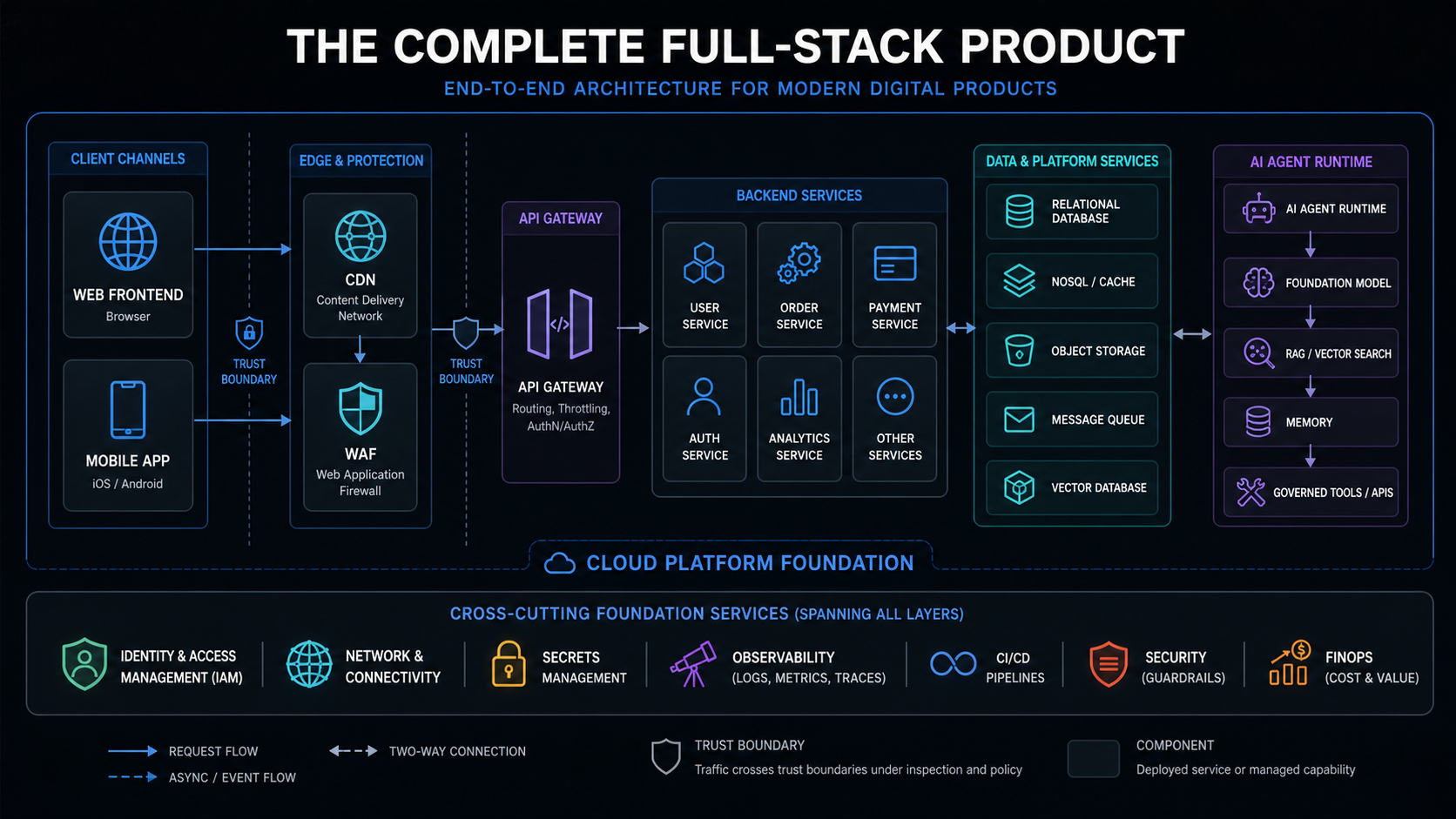
| Layer | Primary responsibility | Must not own |
|---|---|---|
| Web frontend | Rendering, interaction, client state and accessibility | Secrets or authoritative business rules |
| Mobile app | Navigation, lifecycle, offline cache and device APIs | Trusted authorization decisions |
| Edge and gateway | TLS, WAF, routing, throttling and token checks | Core business workflow |
| Backend services | Authorization, validation, transactions, APIs and events | Presentation-specific rendering |
| Relational database | Orders, payments, users, constraints and ACID changes | UI state or semantic search |
| NoSQL, cache and object storage | Fast lookups, sessions, documents, media and files | Replacing the system of record without design |
| Vector database | Embeddings, similarity search and RAG metadata | Authoritative permissions or transactions |
| AI agent runtime | Reasoning, orchestration, memory and governed tools | Unlimited database or infrastructure access |
| Cloud platform | IAM, network, secrets, deployment, resilience, telemetry and cost | Application requirements and domain meaning |
One architecture, three cloud implementations
| Architecture capability | AWS example | Microsoft Azure example | Google Cloud example |
|---|---|---|---|
| Web frontend and CDN | S3 + CloudFront | Static Web Apps/Storage + Front Door | Cloud Storage/Firebase Hosting + Cloud CDN |
| API entry | API Gateway + WAF | API Management + Front Door WAF | API Gateway/Apigee + Cloud Armor |
| Backend runtime | ECS/Fargate, Lambda or EKS | Container Apps, Functions or AKS | Cloud Run, functions or GKE |
| Transactional database | RDS/Aurora | Azure SQL Database/PostgreSQL | Cloud SQL/AlloyDB |
| Cache and messaging | ElastiCache + SQS/EventBridge | Azure Cache + Service Bus/Event Grid | Memorystore + Pub/Sub/Eventarc |
| Object storage | S3 | Blob Storage | Cloud Storage |
| AI model and agent | Bedrock + AgentCore | Microsoft Foundry + Agent Service | Vertex AI + Agent Engine |
| Identity and secrets | IAM + Secrets Manager | Entra/Managed Identity + Key Vault | Cloud IAM + Secret Manager |
| Observability | CloudWatch/X-Ray | Azure Monitor/Application Insights | Cloud Monitoring/Logging/Trace |
The architecture in one sentence
One user action across the complete stack
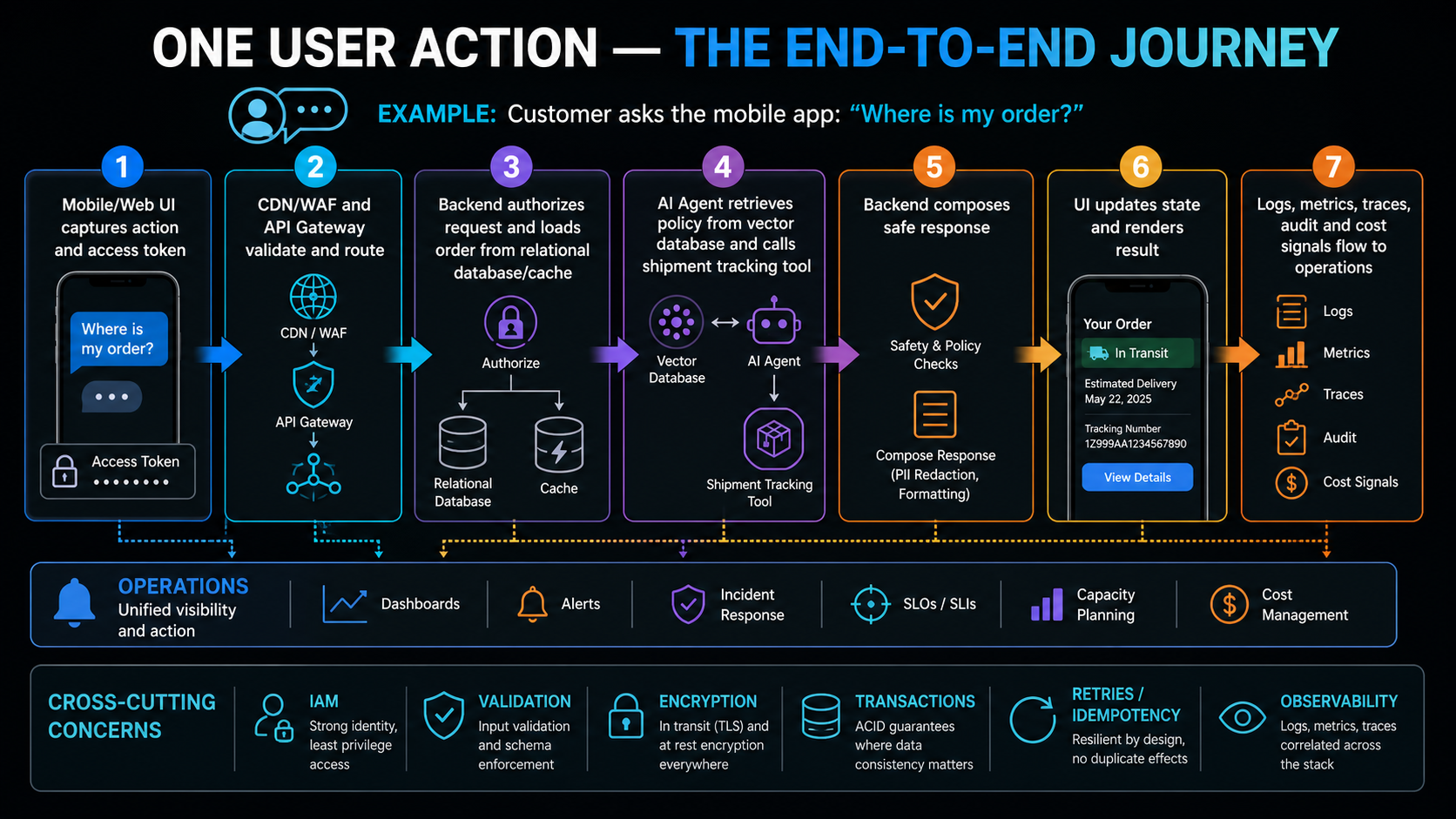
- Frontend or mobile: captures “Where is my order?”, carries the access token and displays loading state.
- Cloud edge: DNS/CDN/WAF receives the request; the gateway validates, throttles and routes it.
- Backend: authenticates the principal, authorizes order access and loads transactional data.
- Databases: relational storage remains authoritative; a cache may accelerate safe repeat reads.
- AI agent: retrieves permitted policy context from vector search and calls a narrowly scoped shipment tool.
- Backend response: validates tool output, applies policy, redacts sensitive data and returns a stable contract.
- UI: updates state and renders success, empty, error or retry behavior.
- Operations: correlated logs, metrics, traces, audits and costs describe the journey.
Identity flows
User identity reaches the backend; services and tools use separate workload identities.
Data has owners
Transactional truth, cached copies, files, vector knowledge and agent memory have different roles.
Failures are normal
Timeouts, bounded retries, idempotency, queues and graceful UI states contain failure.
Everything is observable
One correlation ID connects browser, gateway, backend, database, agent and tool traces.
GET /api/orders/ORD-1042/status
Authorization: Bearer <user-token>
X-Correlation-ID: 7f4a...

{
  "orderId": "ORD-1042",
  "status": "IN_TRANSIT",
  "estimatedDelivery": "2026-08-28",
  "explanation": "Your parcel has left the Bengaluru hub.",
  "source": "shipment-tracking",
  "asOf": "2026-08-26T14:40:00Z"
}Final six-question architecture review
- Who is the user or workload principal?
- Which backend capability owns this action?
- Which data store is authoritative, and which stores are derived?
- What may the agent read or change—and where is approval required?
- What happens when a dependency is slow, unavailable or called twice?
- How will telemetry, audits and cost prove what happened?